Showing posts with label Rightward shift. Show all posts

Thursday, March 19, 2015

The Christian Right Still dominates the GOP -- Is There Any End in Sight?


By Amanda Marcotte
Progressive America Rising via AlterNet

March 18, 2015 - In a recent interview on Fox, Christian right writer [3] James Robison went off on a rant about how Christian conservatives need to take over the government: “There are only 500 of you,” Robison said of Congress. “We can get rid of the whole bunch in one smooth swoop and we can really reroute the whole ship!”

He added that this takeover would cause "demons to shudder" and the "gates of hell to tremble," but what was really delusional about it was the idea that Congress is somehow devoid of Christians. In reality, 92% of Congress people identify [4] as Christian. More to the point, nearly every Republican, regardless of their sincerity in saying so, aligns with conservative Christianity, whether Catholic or Protestant, an affiliation reflected in their policy preferences. (One solitary Republican is Jewish.) The Christian right might not own all 535 members of Congress, but with Republicans in the majority, the Christian right is also in the majority.

And yet, as New York Times writer Jason Horowitz explained in a recent profile piece about evangelical organizer David Lane, Lane feels quite similarly: “For Mr. Lane, a onetime Bible salesman and self-described former “wild man,” connecting the pastors with two likely presidential candidates was more than a good day’s work. It was part of what he sees as his mission, which is to make evangelical Christians a decisive power in the Republican Party.”

Say what, said any reader who has cracked a newspaper, the New York Times or otherwise, in the past four decades. Making the Republican Party beholden to the Christian right is like making the sky blue or making cats stubborn. Can you really make something be what it already is?

That the evangelical right already controls the GOP shouldn’t really be in dispute. Not only do the Republicans do exactly as the Christian right tells them on every social issue, such as reproductive rights or gay rights, but Republicans also pay fealty to the Christian right by targeting Muslim countries with their hawkish posturing or using [5] Christian language to rationalize slashing the social safety net. If you were trying to come up with a quick-and-dirty description of the Republican Party, “coalition of corporate and patriarchal religious interests” would be it. (Continued)

Read More...

Monday, February 16, 2015

Moral Mondays’ Barber Says America’s Political System Suffers From a ‘Heart Problem’

Saturday’s Moral Mondays march once again brought a multicultural crowd of thousands to Raleigh, N.C., protesting budget cuts and voting restrictions enacted by the state’s Republican Legislature.

Planned Parenthood Federation of America President Cecile Richards and NAACP National President Cornell Brooks (far right) listen to the North Carolina NAACP’s the Rev. Dr. William Barber speak at the Moral Mondays march in downtown Raleigh, N.C., Feb. 14, 2015.

By David Swerdlick
The Root

Raleigh, N.C., Saturday, Feb. 14: An African-American Muslim imam, Oliver Muhammad, offered the call to prayer; members of black Greek-letter fraternities served as event marshals; and as marchers in North Carolina’s Moral Monday movement began their walk across downtown Raleigh, the state’s capital, Chapel Hill Town Council member Maria Teresa Palmer announced—in Spanish—that “interpreters will be available at the intersection of Hargett and Fayetteville.”

It’s that kind of come-one, come-all event. And even though this year’s ninth annual march wasn’t as big as last year’s—one that The Nation’s Ari Berman reported as “the largest civil rights rally in the South since the Selma to Montgomery march in 1965”—organizers again brought together a diverse coalition of activists on a chilly Valentine’s Day to protest what movement leader and state NAACP President the Rev. Dr. William Barber II described as the state’s—and the nation’s—“heart problem.”

And while the Moral Mondays movement is left-leaning, Barber told supporters that he wanted them to be political “defibrillators” because “we find we’ve got, not a left problem or a right problem or a conservative problem or a liberal problem. We’ve got a heart problem. When money and greed and political hubris and pride and ego and beating your opponent become more important than working together to uplift humanity, we’ve got a heart problem.”

For the movement, the stakes haven’t changed.

Barber called on legislators to “fund Medicaid expansion, raise the minimum wage, index it with inflation—put it on the ballot and let the people vote,” as well as “restore cuts to public education,” reject “the attacks on women’s health and environmental protection, repeal the death penalty, reform the criminal-justice system,” enact “fair immigration reform, and respect the constitutional rights of all humanity, regardless of race, creed, color and sexuality.” (Continued)

Read More...

Tuesday, February 10, 2015

If Voting Means Little, Why Is the Right Working So Hard to Suppress It?

Selma and Shelby: The Fight for the New South

BY JESSE JACKSON
Progressive America Rising

Feb 10, 2015 - What time is it?  It’s important to be clear.  Is it mid-day and our labors still have hours to go?  Or is it evening, our work done, and we can rest our weary heads?  What time is it for the New South?  Is it time to celebrate Selma, Alabama – and the triumph of the Voting Rights Act?  Or is it time to mourn Shelby, Alabama – and the radical backlash against voting rights?

Fifty years after Selma’s Bloody Sunday that led directly to the passage of the Voting Rights Act, many will gather to celebrate that victory.  But we should understand that our work is not done. With the Shelby decision of the Supreme Court, the struggle for equal rights must go on.

Too often, we remember the triumph and ignore the backlash.  In 1870, the 15th Amendment, codified in in the blood of the Civil War, was ratified to give African Americans the right to vote.  It declared that the right to vote shall not be denied “on account of race, color or previous condition of servitude.”

But the triumph was immediately challenged by the backlash.  Across the South, states controlled the structure and laws of voting.  They immediately set up seemingly neutral barriers to voting – poll taxes, literacy tests and more – that were used to disenfranchise black voters.  The reconstruction of the South was ended as the Supreme Court ratified legal apartheid, and segregation was brutally enforced.

It took nearly a century, a mighty civil rights movement, Bloody Sunday and other sacrifices, to pass the Voting Rights Act that gave the Justice Department the right to pre-screen any changes to voting laws in states with a history of discrimination, and ban those that would have a discriminatory effect, even if they looked neutral on their face.

Two years ago, however, in the case of Shelby County v. Holder, the five conservative judges on the Supreme Court effectively gutted preclearance laws, arguing in essence that there as a new South that had moved beyond racism.

Read More...

Thursday, October 23, 2014

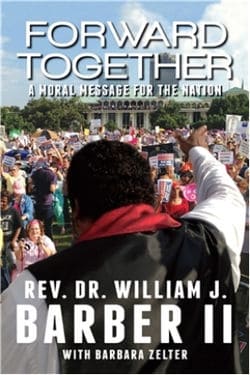
Rev. William Barber’s New Book Reminds Us Why We Must Vote


441_Forward_TogetherBy Terrance Heath

Progressive America Rising via Ourfuture.org

Oct 22, 2014 - With Election Day just two weeks away, the words of Paul Wellstone Citizen Leadership Award  recipient and Moral Mondays movement leader Rev. William Barber remind us, “If we ever needed to vote, we sure do need to vote now!” His new book reminds us of the moral power of progressive values when we march “forward together.”

Rev. Barber’s words come from his 2012 address to the NAACP, but as timely as ever with so much at stake in this election, as Denise Oliver Velez writes:

Election Day 2014 is on Tuesday, November 4, a little over two weeks away. This election will make a profound difference in the lives of many of our citizens. For some, it is a matter of life and death—given the refusal of some states to accept Medicaid expansion. We are all too aware of right-wing extremist efforts in many of those same states to suppress the vote, and to construct obstacles to voting.

One of the most powerful voices in the nation, fighting to mobilize a broad-based coalition of social activists to fight voter suppression, is that of the Rev. Dr. William Barber II. What is disconcerting is that with only a few exceptions, the major traditional media have managed to ignore his voice and the Moral Mondays movement he is leading—from his home base of North Carolina, to as far north as Wisconsin.

How did much of the press manage to ignore 80,000 people who marched in Raleigh, North Carolina, back in February?

While the traditional media is willing to pay homage to Martin Luther King Jr. and Rosa Parks in memorials and tributes, journalists are far too willing to pretend that the civil rights movement was buried with Dr. King. Contrary to those who speak as if the movement ended in 1968, it is alive and growing. Blacks, whites, Latinos, Asians, Native Americans, women and men—straight and LGBT, religious and non-religious, young and old—have come together in a breathtaking and extraordinary fusion movement, Moral Mondays, spearheaded by the Rev. William Barber, head of the North Carolina NAACP. His book about that movement, Forward Together: A Moral Message for the Nation, is being released by Chalice Press November 1.

Just in time for the election, Rev. Barber’s new book from Chalice Press, Forward Together: A Moral Message for the Nation, recalls the beginnings of the historic Moral Mondays movement, puts progressive values in a moral context we can take with us into the voting booth.

Last summer, after seven years of grassroots organizing, “Moral Mondays” grabbed the nation’s attention as thousands protested North Carolina’s General Assembly in Raleigh in support of the poor, voting rights, health care, immigrant rights, and other issues. Over 13 consecutive weeks, the protests against legislative extremism resulted in the arrests of nearly 1,000 people, making it one of the largest acts of civil disobedience in U.S. history. As thousands more gathered in support each Monday, Barber, president of the North Carolina chapter of the NAACP, became widely recognized as the leader of a new civil rights movement in the South. More than 100 “Moral Monday” connected events have since taken place, and the spirit of the movement has spread to Georgia, South Carolina, Virginia, Alabama, Arkansas, Missouri, Wisconsin, and New York. This reflection on the movement’s beginnings introduces Barber, the sources of his courage from both a biblical imagination for justice and a deep connection to “fusion” civil rights history, and the inspiring story of the Southern freedom movement’s revival.

Barber invites readers into a big-tent, faith-based movement for justice that has room for black, white, and brown, gay and straight, rich and poor, old and young, Republicans and Democrats, people from all walks of life. Offering his unique analysis of what he has called the “Third Reconstruction,” Barber locates North Carolina’s struggle in the spiritual and political landscape of 21st-century America. With civil rights and social justice battles with a deep moral narrative, particularly in southern statehouses that then move to federal courts on appeal, what happens in North Carolina can shift the center of gravity in political discourse, debate, and decision—and thereby change the nation.

“Messages of moral dissent are designed not to just be spoken and heard but to shape the prophetic consciousness of a movement and of society,” says Barber. “The prophetic voice rises when government systems and sometimes even religious systems have abdicated their responsibility to the least of these. When the forces of extremism have become so overwhelming and have depressed the hope of the people, the prophetic voice and mission is to connect words and actions in ways that build restorative hope so that there can be a movement for restorative justice. So this book is an attempt to capture the practice of ‘preaching’ in the public square, which is where prophetic inquiry and critique must function.”

Check out Rev. Barber’s book when it drops on November 1st and take his message into the voting booth on November 4th!

Read More...

Tuesday, October 7, 2014

The South’s Victim Complex: How Right-Wing Paranoia is Driving New Wave of Radicals

The South's victim complex: How right-wing paranoia is driving new wave of radicals

(Credit: AP/Dave Martin)

New wingnut neo-Confederates may be laughed at as they enter Washington, D.C. But here's why their anger is deadly serious

By Matthew Pulver

Progressive America Rising via Salon.com

Southern voters will go to the polls in November 150 years, almost to the day, after Gen. Sherman commenced his March to the Sea, breaking the back of the Confederacy and leaving a burnt scar across the South. The wound never fully healed. Humiliation and resentment would smolder for generations. A sense of persecution has always mingled with the rebellious independence and proud notions of the South’s latent power, the promise that it “will rise again!” Congressman Paul Broun Jr., whose Georgia district spans nearly half of Sherman’s calamitous path to Savannah, evoked the “Great War of Yankee Aggression” in a metaphor to decry the Affordable Care Act on the House floor in 2010. The war, in Broun’s formulation, was not a righteous rebellion so much as a foreign invasion whose force still acts upon the South and its ideological diaspora that increasingly forms the foundation of conservatism.

The persecution narrative deployed by Broun, so woven into Southern culture and politics, has gained national currency. Contemporary conservatism is a Southern politics. Ironically, the Southern persecution narrative, born of defeat, has spread nationwide to form the basis of Republican victories since Reagan and the conservative hegemony that moderated President Clinton, establishing through President George W. Bush nearly 40 years of rightward movement at the national level.

It is the South’s principal political export, now a necessary ideological substrate in Republican rhetoric. Lee Atwater, the Karl Rove of the Reagan era, explained the nationalization of Southern politics accomplished with the 1980 campaign and election of President Reagan: “The mainstream issues in [the Reagan] campaign had been, quote, ‘Southern’ issues since way back in the Sixties,” Atwater said in 1981. Likely the foremost representative of that Southern mood was Alabama’s George Wallace, who in his 1963 gubernatorial inaugural address, the infamous “Segregation Forever” speech, invoked Robert E. Lee and Jefferson Davis and raged that “government has become our god.” Just months later, that omnipotent force would defeat Wallace when President Kennedy federalized the Alabama National Guard and forced desegregation at the University of Alabama. Wallace, though, would be rewarded for his stand, and the governor carried five Deep South states in his 1968 presidential run.

A century after the Civil War and Reconstruction, the 1960s was a sort of second federal invasion, with the White House strong-arming Wallace, Supreme Court decisions finally implementing Brown’s desegregation order, and the Civil Rights and Voting Rights Acts radically reshaping Southern politics and culture. “The South went from being behind the times to being the mainstream,” Atwater said. It is helpful to consider the inverse: The mainstream GOP adopted the ’60s-era mood of the South. Atwater does not suggest that the South caught up with a modernized conservatism — i.e., that it ceased to be “behind the times” — but that the larger movement regressed, albeit with rhetorical coding to evade charges of old-school racism.

Read More...

Sunday, May 18, 2014

Today’s New Leader, in Prison, Learning from Eugene Debs

A Note From Occupy Wall Street Activist Cecily McMillan

By CECILY MCMILLAN

Good morning. I’m writing from the Rose M. Singer Correctional Facility, dorm 2 East B on Rikers Island – where I’ve been held for the past 4 days.

Admittedly, I was shocked by the jury’s verdict on Monday, but was not surprised by the events that followed. An overreaching prosecutor plus a biased judge logically adds up to my being remanded to Rikers.

I was prepared then, as I am now, to stand by my convictions and face the consequences of my actions – namely that of refusing to forsake my values and what I know to be true in exchange for my “freedom.”

Packed into a room with 45 other women – often restricted to my cot – I’ve had nothing but time to measure the strength of my beliefs alongside that ambiguous concept – “freedom.” (I’ve come to the conclusion that it is far easier to weigh such tradeoffs from the comfort of one’s own bed.)

At Rikers, the day begins with 4:30am breakfast. Milk cartons in hand, the women echo a common set of concerns – “can’t reach my lawyer, my family won’t speak to me, no commissary” – and I become painfully aware of how privileged I am, despite what is supposed to be the great equalizing suffering of the prison experience.

Unlike my peers, I have a hell of a lawyer – Marty Stolar – who made the long journey to hold my hand and promise “I will not stop fighting for you.” I also have a gifted team of friends and organizers – ‪#‎Justice4Cecily‬ – that continue to provide around-the-clock care and mobilize public support. Finally, I’m incredibly lucky to have a vast and very much alive movement at my side, sending me “Occupy Love” from across the world.

Despite how obscenely unbalanced our circumstances are, my new-found friends – who have quickly become my comrades – are outraged by my story and resolve to do their part to keep me out of prison. After lunch, they spend their free time writing letters to Judge Zweibel, defending my character and pleading for leniency.

At 6:00pm dinner, the cramped circle of ladies ask me “What exactly is social justice organizing?” Over the complex choreography of food trading I tell them about Democratic Socialist leader Eugene Victor Debs. How nearly 100 years ago he publicly criticized U.S. involvement in WWI – in violation of the Wartime Sedition Act – and was sentenced to 10 years in prison for exercising his constitutional right to free speech. “Sort of like that,” I explain, “But he’s way out of my league – he’s my hero.”

By lights out, a subtle peace has begun to wash over me. I page through a book stopping at Debs’ speech to the Federal Court of Cleveland, Ohio – I read and reread, as if a personal mantra, these opening lines -

“Your honor, years ago I recognized my kinship with all living beings, and I made up my mind that I was not one bit better than the meanest on earth. I said it then, as I say it now, that while there is a lower class, I am in it, and while there is a criminal element I am of it, and while there is a soul in prison, I am not free.”

At the close of the night, I smile and shut my eyes. As I drift off, “Somehow,” I think, “this is all a part of the plan.”

Cecily McMillan is an activist now serving a sentence in Riker’s Island. This statement first appeared on http://justiceforcecily.com/.

Read More...

Tuesday, April 15, 2014

It’s Official: Scientific Study Says We Are an Oligarchy, Not A Democracy

Now Whaddya Gonna Do About It?

By pajoly

Progressive America Rising via DailyKOS

We like to assert that Daily Kos is a reality-based community. At the very least we surely do not deny science. A new study appearing at Princeton's website may test these assumptions for some of us here. For others, it will be grim vindication of what we already know: the United States of America is no longer a democracy, but rather an oligarchy.

The anecdotes are plentiful, from modest gun control proposals that saw 90% public support, to unemployment compensation, to infrastructure spending, to women's rights; where a plurality exists even across party lines, the median public interest seems to hold no sway in policy making. Now science has proven this to be correct:

The central point that emerges from our research is that economic elites and organized groups representing business interests have substantial independent impacts on U.S. government policy, while mass-based interest groups and average citizens have little or no independent influence. Our results provide substantial support for theories of Economic Elite Domination and for theories of Biased Pluralism, but not for theories of Majoritarian Electoral Democracy or Majoritarian Pluralism.
Distilled down into simple terms: The U.S.A. is now provably an oligarchy; we are a democracy in name only. DINO, as in dinosaur... As in extinct.... Has the acronym ever been more pathetically poignant?

The authors of this study, which will appear in the Fall issue of of the academic journal Perspective on Politics, are Martin Gilens of Princeton University and Benjamin I. Page of Northwestern University. The findings are shocking, but should surprise none. The progressive website Common Dreams (www.commondreams.org/view/2014/04/14) today posted an article on the study and pulls this deeply disturbing nugget from the study.

...the nearly total failure of 'median voter' and other Majoritarian Electoral Democracy theories [of America]. When the preferences of economic elites and the stands of organized interest groups are controlled for, the preferences of the average American appear to have only a minuscule, near-zero, statistically non-significant impact upon public policy.
Since we are not science deniers, we need to do our part to make this report gets the audience it deserves. None here should take comfort in an "I told you so moment," because we are all losers here. Despite the trappings and tradition of a representative democracy, the truth is those are just theatrics. At this point, even the echos of democracy are becoming faint. Spectacles like GOP presidential nominees making the pilgrimage to kiss the ring of King Adelson now happen with full knowledge, the vampires are out of the shadows and discover it's fun in the sun. While satirists rightly lampoon it, media practically celebrates it and the Supreme Court in practice has endorsed it as a victory for the 1st Amendment.

Now that we have science on our side, will we be able to go beyond online outrage? Will the Democratic Party have the courage to fight for the restoration of the public's will?

I'll close with an understated gem from page 24 of the study's published report:

Despite the seemingly strong empirical support in previous studies for theories of majoritarian democracy, our analyses suggest that majorities of the American public actually have little influence over the policies our government adopts. Americans do enjoy many features central to democratic governance, such as regular elections, freedom of speech and association, and a widespread (if still contested) franchise. But we believe that if policymaking is dominated by powerful business organizations and a small number of affluent Americans, then America’s claims to being a democratic society are seriously threatened.
The bold is from me. The warning is from science.

Tue Apr 15, 2014 at 12:54 AM PT: I woke to share the blood moon with one of my young daughters, so I thought I'd run through the comments before heading back to bed. I see lots of "well no shit, water is wet" responses. While this is obvious to even casual observers, scientific validation is important as it elevates the discussion and can't be disregarded as mere whining by the 99.9%. It is provides both meat and hammer in the messaging.

Tue Apr 15, 2014 at  6:34 AM PT: I reached out to the authors and received a reply from Ben Page. He hopes their work will be used as part of evidence-based debate and he was pleased the work is gaining wider audience.

Tue Apr 15, 2014 at 12:03 PM PT: A commenter makes note from one of HoundDog's diaries that the data used for this study was drawn from study of public policy 1,779 instances between 1981 and 2002. Did you get that....2002...In other words the closing set of data PRE-dates the years most of us would say were when the oligarchs truly built steam. Think of what's unaccounted for: the Iraq War, OWS, drones and the NSA, Citizen's United and now McCutcheon. One has to think if the last 13 years had also been accessed, the conclusions would be much more dire than even they already are.

Read More...

Tuesday, March 11, 2014

The Right Wants Workers on Their Knees

'They're Not Dead Yet': Planning The Demise Of Labor Unions At CPAC

By David Jamieson

Progressive America Rising via Huffington Post

March 8, 2014 - NATIONAL HARBOR, Md. -- Any right-wing confab probing the power of "big labor" suffers from an inherent contradiction: The ranks of unionized workers in the U.S. have never been so thinned, with less than 7 percent of the private sector now belonging to a labor union. A successful anti-union discussion therefore needs to strike a delicate balance, celebrating unions' diminished state while simultaneously insisting they pose as grave a threat as ever.

This rhetorical needle was ably threaded on Saturday morning by anti-tax crusader Grover Norquist, who moderated a panel at the Conservative Political Action Conference entitled "On Wisconsin! Turning Blue States Red." The panel sought to answer a strategic question for the right: "After Wisconsin and beyond right-to-work laws, what’s possible now to free workers and students from unionism?"

While acknowledging that union membership has fallen to a historic low, Norquist began the discussion by claiming that unions are the greatest political force in America at the moment.

"They're not dead yet -- they're in decline," Norquist said. "They raise maybe $7 billion a year in dues. Imagine how much they spend of that on politics. They are the largest political player in American politics and will be for some time. What can we do about it?"

Better known for his tax work, Norquist has quickly become a major figure among anti-union activists through the Center for Worker Freedom, an arm of his group Americans for Tax Reform. Norquist's crew bankrolled the anti-union billboards plastered throughout the Chattanooga, Tenn., area in the runup to the United Auto Workers' ill-fated union vote at a Volkswagen plant there last month.

The UAW's narrow loss, by a 53 to 47 margin, was a stinging defeat for organized labor and a major setback for the union's plans in the South. The UAW has accused Norquist and a host of Republican politicians -- including Sen. Bob Corker (Tenn.) -- of unfairly meddling in the election as third parties and possibly tainting the results.

Many UAW opponents on the right said they were concerned the union's presence would hurt the plant's expansion plans or make it harder to attract new businesses to Tennessee. But one of Norquist's panelists, Terry Scanlon, president of the Capital Research Center, seemed to acknowledge Saturday that the true fight in Chattanooga was a political one. This was the "unmentionable" that Scanlon nonetheless mentioned.

"What is really good here is the unmentionable: There will be so much less money without all these dues, 90-some percent in most cases, going to Democrats," Scanlon said during the panel. "Without the money there, it's not going to happen. This is great news. It's great news."

Norquist didn't dwell on his Tennessee victory, instead steering the discussion toward a larger picture: how the right can fundamentally weaken unions through state legislation. That includes collective bargaining rollbacks like the monumental one carried out by Gov. Scott Walker (R) in Wisconsin in 2011, as well as right-to-work laws like those recently passed in Michigan and Indiana. Right-to-work laws forbid contracts between companies and unions that require all workers to pay the union for bargaining on their behalf, thereby diminishing unions' clout.

The panelists agreed that after seeing Michigan, the cradle of the U.S. auto industry, go right-to-work in 2012, almost anything seemed possible.

"The good news is you have 24 states today with a Republican governor and both houses of the legislature who are Republican," Scanlon said. "You have a shot at right-to-work in any of these states. ... It can be done. It takes time, and you have to set the mechanism up even if you don't have a majority of Republicans."

F. Vincent Vernuccio, director of labor policy at the free-market think tank Mackinac Center for Public Policy, said Republican governors and state lawmakers needn't worry about political repercussions from fast-tracking a right-to-work law through the legislature. Republicans are still standing in places like Indiana, he said.

"When a politician says right-to-work is simply unattainable and they're worried about their job, look at the states that passed right-to-work," Vernuccio said.

Public-sector union membership remains robust, at 35 percent, but anti-union conservatives smell vulnerability. As Norquist noted, the prevailing attitude used to be that "you can't do anything about the public sector." That's no longer the case, particularly after Wisconsin, where most public-sector workers have lost their collective bargaining rights (and where public-sector unions have since lost many of their dues-paying members).

Panelist Reince Priebus, chairman of the Republican National Committee, said that the key to gutting public-sector bargaining rights in Wisconsin was deference to the cause throughout Wisconsin's right flank. It was agreed that they would all share mutually in the glory, Priebus said.

"Americans for Prosperity, Tea Party groups, the GrandSons of Liberty, the 9-12'ers were involved -- it was a total and complete agreement that nobody cared who got the credit, that everyone was going to run down the tracks together and help each other where we could," Priebus said.

Despite such victories, Norquist warned that Obama "owed" something to unions after failing to shepherd through Congress the Employee Free Choice Act, a bill that would have made it easier for workers to unionize. Norquist said it was a political mistake for Obama to prioritize the Affordable Care Act before EFCA, since he could have helped grow the ranks of organized labor to Democrats' benefit. But that failure has left him with a debt to unions, Norquist argued.

"That's why you're seeing the National Labor Relations Board out there putting their thumbs on the scale, and that's going to be a big problem for us in the next three years," Norquist said of the independent agency that enforces labor law. Obama has "stacked" the five-member board, in Norquist's words. (He has appointed three members of his own party and two from the opposition, in keeping with tradition.)

With Democrats holding a majority in the Senate and Obama in the White House, there's little chance of any anti-union laws coming out of Washington anytime soon. But the panelists said they see plenty more opportunity at the state level. When Norquist asked Vernuccio to rattle off some right-to-work targets, he didn't hesitate.

"We're looking at Ohio. We're looking at Missouri. We're looking at Kentucky," Vernuccio said. "The fire of worker freedom is shining brightly, and it is spreading."

Read More...

Tuesday, February 18, 2014

UAW: Unions Need New Strategy

Reflections on the defeat suffered by the TN workers in Volkswagen

By Bill Fletcher, Jr.

Progressive America Rising via BillFletcherJr.com

Feb 18 , 2014 · The election loss at the Chattanooga plant of VW was, first and foremost, a loss suffered by the workers.  Secondarily it was a loss suffered by the United Auto Workers.  The workers at that facility lost the chance to bargain collectively and to obtain a voice in their workplace.  This was a loss that was mainly the result of the all-out right-wing offensive that took place in TN against the workers and their–the workers’–decision to seek representation. And, as is the case for all workers who lack collective bargaining (or the even rarer personal contract), they remain in a free-fire zone where they can be removed from their job for any reason or no reason as long as the reason does not violate statute.   I am sorry; i just needed to cut to the chase.

Yet, we cannot stop there with our reflections on what transpired.  This was a situation where the company–VW–agreed to be neutral and, in many ways, seemed to welcome the union.  Nevertheless, by a relatively slim majority, the proponents of workers’ rights did not prevail.   This reality emphasizes the point that employer neutrality, while important, is insufficient.  There are larger factors at stake when workers must make a decision on union representation, particularly in a period where labor unions have been under such vicious assault.  The decision, in this case, of the Republican Party and others on the political Right to draw a line in the sand and go all out to intimidate the workforce is a case-in-point.  The workers, their families and friends had to decide whether the threats coming from the political Right were genuine or just rhetoric.  Given the history of anti-worker repression in the South, along with the on-going racist efforts to secure a ‘white bloc’ against progress, the messages of the political Right came through loud and clear.

At the same time there was another factor that i found particularly striking.   It was mentioned in an article on the election in the Washington Post yesterday (Monday).  They indicated that within the anti-union vote there were those who were angered by the UAW’s willingness to keep the wages and benefits of VW workers in TN ‘competitive.’  This was particularly interesting because herein lay a critique of the UAW that may have surprised many people.  The workers were saying that they did not want to guarantee to VW that their wages would stay below those of Chrysler, Ford or GM workers.

The UAW finds itself in a bind.  For more than thirty years it has engaged in concessionary bargaining with employers under the banner of “jointness.”  Only a few years ago it approved a two-tier agreement by which the wage and benefit package for incoming workers would differ from veteran workers.  Two-tier systems are by their very nature demoralizing and undermine any real sense of solidarity.  They are also a poison pill that can kill the patient over time as the newer workers come to resent the benefits that they do not have, but which are held by the veteran workers.  Jointness, two tier concessions and a failure–until relatively recently–to develop innovative approaches toward organizing auto “transplants” and auto parts manufacturers in the South have come back to bite the UAW, and to bite with fangs of steel.

The defeat in TN will lead some commentators to suggest that organizing in the South, or in any hostile environment, is pointless short of changes in labor law.  Such conclusions, which we hear periodically, are ahistoric and defeatest.   Yet there are sobering conclusions, or at least suggestions that must be considered.  With all due respect, let me propose a few.

One, the UAW needs to build a local union in that TN plant.  The fact that the election was lost should not mean that the union disappears.  Rather, there is the notion that has become increasingly popular over the last 20 years of what are called “non-majority unions,” that is, unions that are organized in a situation where they have not won majority status and, therefore, cannot bargain collectively, but where they can organize the workers and build alternative forms of representation.   The UAW needs to make that commitment and flip the script.

Two, as is being attempted by the UAW in Mississippi, organizing must look very differently than in the past.  The battle is not simply, only and some cases, mainly between the workers and the employer.  In the case of Chattanooga, VW was not opposed to the union, for example.  Yet in organizing a labor union we must be clear that this is and always has been about power–who has it and who does not.  Thus, organizing a union really must be a community affair.  It must be a matter that involves and engages not only the directly affected workers but also their families, friends and neighbors.  The community must see in unionization an economic development strategy that makes sense. They must also see in unionization a strategy to fight back against the gross injustices that workers feel every day.

Three, grass roots political education and political action is key.  The political Right mobilized its various forces against this unionization effort.  Workers and their unions cannot sit back and await a Democratic Party response to such a travesty.  Workers need locally-based political associations and organizations that can mobilize in order to both advance a progressive project but to also move against the political Right.  Champions of workers rights must create a bit of mischief thereby destabilizing our opponents.  That ranges from an active presence in the media to legislative initiatives that advance workers’ rights to electoral campaigns against the demons who wish to keep the workers in bondage.

Four, and this is a difficult one, the UAW will need to look at itself.  The UAW is not by itself in this challenge, i might add.  Today’s unions were constructed in a very different environment.  In many cases they are led–at the national and local levels–by very sincere individuals who continue to fight the ‘last war.’  In the case of the UAW, the leaders and members probably need to seize this time to reflect on the strategy of jointness; on two-tier systems; on their failure to take an aggressive approach to organizing the auto parts industry; and why it has taken so long to make a serious and on-going effort to unionize the South.  Such a discussion will be complicated and painful, but in the absence of such an examination, the UAW will continue to die the death of a thousand cuts.  And, more importantly, workers in this country who so desperately need unionization, will continue to feel the boot of corporate America and their right-wing allies on our collective necks.

Read More...

Wednesday, October 9, 2013

Getting Inside the Heads of the GOP Base: Tea Party, Evangelical and Moderate

Inside the GOP: Report on focus groups with Evangelical, Tea Party, and moderate Republicans
By Stan Greenberg, James Carville, and Erica Seifert
Democracy Corps / Greenberg Quinlan Rosner Research
If you want to understand the government shutdown and crisis in Washington, you need to get inside the base of the Republican Party.  That is what we are doing in the Republican Party Project and these focus groups with Evangelicals, Tea Party, and moderate Republicans. All the passion, nuances and divisions found expression when we conducted this work in the summer.
Over the last two months, we have been releasing initial findings from the first phase of research for Democracy Corps' new Republican Party Project.  This report details findings from six focus groups among Republican partisans-divided into Evangelicals, Tea Party adherents, and moderates.  All participants indicated that they voted only or mostly for Republican candidates and were screened on a battery of ideological and political indicators.  The groups were conducted in Raleigh, North Carolina (moderate and Tea Party), Roanoke, Virginia (Tea Party and Evangelical), and Colorado Springs, Colorado (moderate and Evangelical.)
clip_image002
Understand that the base thinks they are losing politically and losing control of the country - and their starting reaction is "worried," "discouraged," "scared," and "concerned" about the direction of the country - and a little powerless to change course.  They think Obama has imposed his agenda, while Republicans in DC let him get away with it. 
We know that Evangelicals are the largest bloc in the base, with the Tea Party very strong as well.  For them, President Obama is a "liar" and "manipulator" who has fooled the country.  It is hard to miss the deep disdain-they say the president is a socialist, the "worst president in history," and "anti-American."
For all that, this is a deeply divided base.  Moderates are a quarter of those who identify Re-publican, and they are very conscious of their discomfort with other parts of the party base.  Their distance begins with social issues, like gay marriage and homosexuality, but it is also evident on immigration and climate change.  Fiscal conservatives feel isolated in the party. 
Evangelicals who feel most threatened by trends embrace the Tea Party because they are the ones who are fighting back.  They are very in tune politically, but the Tea Party base is very libertarian and not very interested in fighting gay marriage. 
Republicans shutdown the government to defund or delay Obamacare.  This goes to the heart of Republican base thinking about the essential political battle. They think they face a victorious Democratic Party that is intent on expanding government to increase dependency and therefore electoral support.  It starts with food stamps and unemployment benefits; expands further if you legalize the illegals; but insuring the uninsured dramatically grows those de-pendent on government.  They believe this is an electoral strategy-not just a political ideology or economic philosophy.  If Obamacare happens, the Republican Party may be lost, in their view. 
And while few explicitly talk about Obama in racial terms, the base supporters are very conscious of being white in a country with growing minorities.  Their party is losing to a Democratic Party of big government whose goal is to expand programs that mainly benefit minorities. Race remains very much alive in the politics of the Republican Party.
These are strong common currents in the Republican base, but the thinking and passions are very distinct and telling among the key blocs - and those have consequences for those who seek to lead. We selected these three groups (Evangelicals, non-Evangelical Tea Party adherents, and moderates) because combined they represent almost all of today's Republican partisans. The focus group locations, demographic characteristics, and participants' ideological characteristics were all selected based on statistical analysis of our first survey for this project.  While these are focus groups, and not statistically representative, this analysis gives a real, robust, and serious snapshot of who these Republicans are, how they think, and what matters to them.
--Evangelicals.  Social issues are central for Evangelicals and they feel a deep sense of cultural and political loss.  They believe their towns, communities, and schools are suffering from a deep "culture rot" that has invaded from the outside.  The central focus here is homosexuality, but also the decline of homogenous small towns.  They like the Tea Party because they stand up to the Democrats.
--Tea Party.  Big government, Obama, the loss of liberty, and decline of responsibility are central to the Tea Party worldview.  Obama's America is an unmitigated evil based on big government, regulations, and dependency.  They are not focused on social issues at all.  They like the Tea Party because it is getting "back to basics" and believe it has the potential to reshape the GOP.
--Moderates.  Moderates are deeply concerned with the direction of the country and believe Obama has taken it down the wrong path economically.  They are centrally focused on market-based economics, small government, and eliminating waste and inefficiency.  They are largely open to progressive social policies, including on gay marriage and immigration.  They disdain the Tea Party and have a hard time taking Fox News seriously.
1. Focus groups as real life
When a Macomb County focus group participant shot back, "No wonder they killed him" after I read a statement by Robert Kennedy, that stopped me and led to a whole new analysis of Reagan Democrats - and what were the core blockages to working whites voting Democratic again.  These groups with core Republican voters had similar moments - but more important, these emerged as affinity groups where the participants worked through their alienation and isolation, not just from politically correct-liberal dominated media, but other Republicans, family members, and neighbors.  If you want to know why Republicans are at war internally, start with their voters who are in turmoil.
Read more...

Read More...

Wednesday, August 14, 2013

America’s Descent Into Madness

America has entered one of its periods of historical madness, but this is the worst I can remember: worse than McCarthyism, worse than the Bay of Pigs and in the long term potentially more disastrous than the Vietnam War.

    – John le Carré

By Henry A. Giroux
Progressive America Rising via Counterpunch

August 13, 2013 - The stories it now tells are filled with cruelty, deceit, lies, and legitimate all manner of corruption and mayhem.  The mainstream media spins stories that are largely racist, violent, and irresponsible —stories that celebrate power and demonize victims, all the while camouflaging its pedagogical influence under the cheap veneer of entertainment.

Unethical grammars of violence now offer the only currency with any enduring value for mediating relationships, addressing problems, and offering instant pleasure. A predatory culture celebrates a narcissistic hyper-individualism that radiates a near sociopathic lack of interest in or compassion and responsibility for others. Anti-public intellectuals dominate the screen and aural cultures urging us to shop more, indulge more, and make a virtue out of the pursuit of personal gain, all the while promoting a depoliticizing culture of consumerism.

Undermining life-affirming social solidarities and any viable notion of the public good, right-wing politicians trade in forms of idiocy and superstition that mesmerize the illiterate and render the thoughtful cynical and disengaged.   Military forces armed with the latest weapons from Afghanistan play out their hyper-militarized fantasies on the home front by forming robo SWAT teams who willfully beat youthful protesters and raid neighborhood poker games.  Congressional lobbyists for the big corporations and defense contractors create conditions in which war zones abroad can be recreated at home in order to provide endless consumer products, such as high tech weapons and surveillance tools for gated communities and for prisons alike.

The issue of who gets to define the future, own the nation’s wealth, shape the reach of state resources, control of the global flows of goods and humans, and invest in institutions that educate an engaged and socially responsible citizens has become largely invisible.  And yet these are precisely these issues that offer up new categories for defining how matters of representations, education, economic justice, and politics are to be defined and fought over. The stories told by corporate liars and crooks do serious harm to the body politic, and the damage they cause together with the idiocy they reinforce are becoming more apparent as America descends into authoritarianism, accompanied by the pervasive fear and paranoia that sustains it.

Read More...

Monday, July 8, 2013

Defending the Constitution: Snowden Made the Right Call When He Fled the U.S.

Daniel Ellsberg is the author of “Secrets: A Memoir of Vietnam and the Pentagon Papers.” He was charged in 1971 under the Espionage Act as well as for theft and conspiracy for copying the Pentagon Papers. The trial was dismissed in 1973 after evidence of government misconduct, including illegal wiretapping, was introduced in court.

By Daniel Ellsberg

Progressive America Rising via Washington Post

Many people compare Edward Snowden to me unfavorably for leaving the country and seeking asylum, rather than facing trial as I did. I don’t agree. The country I stayed in was a different America, a long time ago.

After the New York Times had been enjoined from publishing the Pentagon Papers — on June 15, 1971, the first prior restraint on a newspaper in U.S. history — and I had given another copy to The Post (which would also be enjoined), I went underground with my wife, Patricia, for 13 days. My purpose (quite like Snowden’s in flying to Hong Kong) was to elude surveillance while I was arranging — with the crucial help of a number of others, still unknown to the FBI — to distribute the Pentagon Papers sequentially to 17 other newspapers, in the face of two more injunctions. The last three days of that period was in defiance of an arrest order: I was, like Snowden now, a “fugitive from justice.”

Yet when I surrendered to arrest in Boston, having given out my last copies of the papers the night before, I was released on personal recognizance bond the same day. Later, when my charges were increased from the original three counts to 12, carrying a possible 115-year sentence, my bond was increased to $50,000. But for the whole two years I was under indictment, I was free to speak to the media and at rallies and public lectures. I was, after all, part of a movement against an ongoing war. Helping to end that war was my preeminent concern. I couldn’t have done that abroad, and leaving the country never entered my mind.

There is no chance that experience could be reproduced today, let alone that a trial could be terminated by the revelation of White House actions against a defendant that were clearly criminal in Richard Nixon’s era — and figured in his resignation in the face of impeachment — but are today all regarded as legal (including an attempt to “incapacitate me totally”).

I hope Snowden’s revelations will spark a movement to rescue our democracy, but he could not be part of that movement had he stayed here. There is zero chance that he would be allowed out on bail if he returned now and close to no chance that, had he not left the country, he would have been granted bail. Instead, he would be in a prison cell like Bradley Manning, incommunicado.

He would almost certainly be confined in total isolation, even longer than the more than eight months Manning suffered during his three years of imprisonment before his trial began recently. The United Nations Special Rapporteur for Torture described Manning’s conditions as “cruel, inhuman and degrading.” (That realistic prospect, by itself, is grounds for most countries granting Snowden asylum, if they could withstand bullying and bribery from the United States.)

Snowden believes that he has done nothing wrong. I agree wholeheartedly. More than 40 years after my unauthorized disclosure of the Pentagon Papers, such leaks remain the lifeblood of a free press and our republic. One lesson of the Pentagon Papers and Snowden’s leaks is simple: secrecy corrupts, just as power corrupts.

In my case, my authorized access in the Pentagon and the Rand Corp. to top-secret documents — which became known as the Pentagon Papers after I disclosed them — taught me that Congress and the American people had been lied to by successive presidentsand dragged into a hopelessly stalemated war that was illegitimate from the start.

Snowden’s dismay came through access to even more highly classified documents — some of which he has now selected to make public — originating in the National Security Agency (NSA). He found that he was working for a surveillance organization whose all-consuming intent, he told the Guardian’s Glenn Greenwald, was “on making every conversation and every form of behavior in the world known to them.”

It was, in effect, a global expansion of the Stasi, the Ministry for State Security in the Stalinist “German Democratic Republic,” whose goal was “to know everything.” But the cellphones, fiber-optic cables, personal computers and Internet traffic the NSA accesses did not exist in the Stasi’s heyday.

As Snowden told the Guardian, “This country is worth dying for.” And, if necessary, going to prison for — for life.

But Snowden’s contribution to the noble cause of restoring the First, Fourth and Fifth amendments to the Constitution is in his documents. It depends in no way on his reputation or estimates of his character or motives — still less, on his presence in a courtroom arguing the current charges, or his living the rest of his life in prison. Nothing worthwhile would be served, in my opinion, by Snowden voluntarily surrendering to U.S. authorities given the current state of the law.

I hope that he finds a haven, as safe as possible from kidnapping or assassination by U.S. Special Operations forces, preferably where he can speak freely.

What he has given us is our best chance — if we respond to his information and his challenge — to rescue ourselves from out-of-control surveillance that shifts all practical power to the executive branch and its intelligence agencies: a United Stasi of America.

Read more on this topic: Eugene Robinson: We can handle the truth on NSA spying The Post’s View: Plug these leaks Marc A. Thiessen: The danger of what Edward Snowden has not revealed David Ignatius: Fallout from Snowden’s sharing of NSA secrets

© The Washington Post Company

Read More...

Wednesday, June 26, 2013

The Right’s War on Democratic Rights

By Tom Hayden

Progressive America Rising

With the fiftieth anniversary of the 1963 March on Washington approaching, is the time at hand for mass protest and civil disobedience against the Republican/Tea Party's war against voting rights and immigrant rights?

That's among the immediate questions as the Roberts Court has dropped its hammer on the 1965 Voting Rights Act while a dubious "immigration reform" bill passed the Senate on its likely way to an even worse fate in the Tea Party-controlled House. Together with the Court's Citizens United decisions protecting secret money in campaigns, Republicans are doing everything possible to cement a grip on power as a numerical white minority bloc. Successful Republican efforts to gerrymander House seats to gain ground in the Electoral College, combined with the rising tide of anti-abortion restrictions in southern states, reinforce the drift towards a new civil war - one fought by political means with recurring episodes of mass violence. The Court's narrowing of affirmative action also guarantees a widening of the racial divide in education and economic opportunity.

The Court's composition reveals its underlying partisan character, with the decisive tilt occurring after the 2000 election between Al Gore, Ralph Nader and George Bush, in which the Court usurped the verdict of a majority of voters, thus becoming a de facto branch of the Republican apparatus. The Republican bloc now includes: Roberts [Bush, 2005], Alito [Bush, 2006], Scalia [Reagan, 1986], Kennedy [Reagan, 1988], and Thomas [Bush, sr., 1991]. The Democratic bloc includes Ginsberg [Clinton, 1993], Stephen Breyer [Clinton, 1994], Sonia Sotomayer [Obama, 2009], and Elena Kagan [Obama, 2010]. The Republican tilt is likely to continue indefinitely, with Obama only able to appointment replacements to retiring liberals. The tilt will become a lock if a Republican president is elected in 2016.

Lost in both the partisan spin and rhetorical legalisms is that the scale of political power is being tipped far to the right in spite of progressive majorities which elected and re-elected President Obama.

Read More...

Wednesday, February 20, 2013

Tea Party Origins: ‘We’re Shocked!’

Study Confirms Tea Party Was Created by Big Tobacco and Billionaire Koch Brothers

By Brendan DeMelle

Progressive America Rising via HuffPost

Feb 11, 2013 - A new academic study confirms that front groups with longstanding ties to the tobacco industry and the billionaire Koch brothers planned the formation of the Tea Party movement more than a decade before it exploded onto the U.S. political scene.

Far from a genuine grassroots uprising, this astroturf effort was curated by wealthy industrialists years in advance. Many of the anti-science operatives who defended cigarettes are currently deploying their tobacco-inspired playbook internationally to evade accountability for the fossil fuel industry's role in driving climate disruption.

The study, funded by the National Cancer Institute of the National Institute of Health, traces the roots of the Tea Party's anti-tax movement back to the early 1980s when tobacco companies began to invest in third party groups to fight excise taxes on cigarettes, as well as health studies finding a link between cancer and secondhand cigarette smoke.

Published in the peer-reviewed academic journal, Tobacco Control, the study titled, 'To quarterback behind the scenes, third party efforts': the tobacco industry and the Tea Party, is not just an historical account of activities in a bygone era. As senior author, Stanton Glantz, a University of California, San Francisco (UCSF) professor of medicine, writes:

"Nonprofit organizations associated with the Tea Party have longstanding ties to tobacco companies, and continue to advocate on behalf of the tobacco industry's anti-tax, anti-regulation agenda."

The two main organizations identified in the UCSF Quarterback study are Americans for Prosperity and Freedomworks. Both groups are now "supporting the tobacco companies' political agenda by mobilizing local Tea Party opposition to tobacco taxes and smoke-free laws." Freedomworks and Americans for Prosperity were once a single organization called Citizens for a Sound Economy (CSE). CSE was founded in 1984 by the infamous Koch Brothers, David and Charles Koch, and received over $5.3 million from tobacco companies, mainly Philip Morris, between 1991 and 2004.

Read More...

Sunday, January 6, 2013

‘Flip the Script’ –Jobs over Deficits

Job seekers waiting in line

The Republican Lock on Congress

By Bill Fletcher, Jr.
Progressive America Rising via billfletcherjr.com

There is a strategic question that faces progressives, one that is receiving increased attention.  Due to the 2010 elections and the Republican domination of state legislatures, Congressional Districts have been gerrymandered in order to guarantee a lack of any significant electoral challenges.  In other words, these Districts have Republican Congresspeople who are not worried about opposition.

As we saw in the lead up to the ‘fiscal cliff’ negotiations/resolution, most Republicans felt no internal pressure to compromise.  It is quite likely that they will feel little pressure in their districts for at least ten years.  As a result the sort of pressure that they must feel must transcend their districts and actually be more at the societal level.  What this means is that while progressives absolutely need an independent electoral strategy that builds locally-based organizations capable of successfully running candidates for office–both inside and outside of the Democratic primary system–that is insufficient.

In fact, it is the Occupy Movement that pointed us in the direction of the other leg of such a movement. What the Occupy Movement accomplished, among other things, was to change the social discourse.  Despite every effort by the mainstream media to dismiss the Occupy Movement it not only grew but forced the country to start to address the question of economic inequality.

In the current context the implications should be clear.  If, for instance, we are to fight it out on the economy and specifically on unemployment, this will not happen on the basis of fights in the Republican Congressional Districts.  It will be a fight that we will have to take up in cities, including but not limited to state capitols, around the country.  It means social protests which are disruptive. 

In order for this to happen we must actually re-train many social movement activists and thinkers in the lessons of the 1930s labor movement, the 1950s-1960s freedom movements (including but not limited to the Civil Rights Movement), the movement against the Vietnam War, and the work of the early environmental movement. 

Occupy, in that sense, was onto something.  We must carry out a fight for space as part of the fight for power.  Land occupations, eviction blockades, boycotts, as well as mass demonstrations are all critical.  [Note: in fact, we need, right now, a series of REALLY mass marches for jobs.] In other words, the sort of pressure that needs to be brought about must be something that Republicans AND Democrats feel, and in fact, become a serious source of concern.

Before we find ourselves wallowing in self-pity as we worry about the Republican ‘lock’, let’s rethink our strategy and tactics.  We may be able to flip the script, and sooner rather than in the distant future.

Read More...

Monday, December 31, 2012

The Secret of How the GOP Has a Lock on the House for the Foreseeable Future.

By Bill Berkowitz

Progressive America Rising via Alternet

Dec 29, 2012  - If somewhere in the recesses of your mind you were wondering how, despite President Barack Obama’s re-election victory and the Democratic Party’s gains in the Senate, Republicans continue to control the House of Representatives, think redistricting.

Redistricting is the process that adjusts the lines of a state’s electoral districts, theoretically based on population shifts, following the decennial census. Gerrymandering is often part and parcel of redistricting. According to the Rose Institute of State and Local Governments at Claremont McKenna College, Gerrymandering is done “to influence elections to favor a particular party, candidate, ethnic group.”

Over the past few years, as the Republican Party has gained control over more state legislatures than Democrats. And, it has turned redistricting into a finely-honed, well-financed project. That has virtually insured their control over the House. “While the Voting Rights Act strongly protects against racial gerrymanders, manipulating the lines to favor a political party is common,” the Rose Institute’s Redistricting in America website points out.

ProPublica’s Olga Pierce, Justin Elliott and Theodoric Meyer recently reported, in a piece titled “How Dark Money Helped Republicans Hold the House and Hurt Voters [3],” that “Republicans had a years-long strategy of winning state houses in order to control each state's once-a-decade redistricting process,” That strategy helped the GOP put a hammerlock on its goal of creating safe Republican districts that would allow it to control of the House.

“The Republican effort to influence redistricting overall was spearheaded by a group called the Republican State Leadership Committee [RSLC], which has existed since 2002,” ProPublica reported. “For most of that time, it was primarily a vehicle for donors like health care and tobacco companies to influence state legislatures, key battlegrounds for regulations that affect corporate America. Its focus changed in 2010 when Ed Gillespie, former counselor to President George W. Bush, was named chairman. His main project: redistricting.”

Under Gillespie’s leadership, the RSLC launched a project called the Redistricting Majority Project [4], or REDMAP, “to influence state races throughout the country.” In 2010, the RSLC had raised $30 million to pursue what Karl Rove had discussed earlier that year in a Wall Street Journal article headlined, “The GOP Targets State Legislatures,” and subtitled, "He who controls redistricting can control Congress."

Read More...

Saturday, September 29, 2012

The Economic Platform for a Popular Front vs. Finance Capital & the Right

Let's Fight for a Progressive Agenda

By Senator Bernie Sanders
Progressive America Rising via HuffPost

Sept 29, 21012 - There are two major economic and budgetary issues which Congress must address in the lame-duck session or soon afterward. First, how do we reverse the decline of the middle class and create the jobs that unemployed and underemployed workers desperately need? Second, how do we address the $1 trillion deficit and $16 trillion national debt in a way that is fair and not on the backs of the elderly, the children, the sick or the poor?

Both of these issues must be addressed in the context of understanding that in America today we have the most unequal distribution of income and wealth of any major country on earth and that the gap between the very rich and everyone else is growing wider. Today, the top 1 percent earns more income than the bottom 50 percent of Americans. In 2010, 93 percent of all new income went to just the top 1 percent. In terms of wealth, the top 1 percent owns 42 percent of the wealth in America while the bottom 60 percent owns just 2.3 percent.

In my view, we will not make progress in addressing either the jobs or deficit crisis unless we are prepared to take on the greed of Wall Street and big-money interests who want more and more for themselves at the expense of all Americans. Let's be clear. Class warfare is being waged in this country. It is being waged by the Koch brothers, Sheldon Adeslon, Mitt Romney, Paul Ryan and all the others who want to decimate working families in order to make the wealthiest people even wealthier. In this class war that we didn't start, let's make sure it is the middle class and working families who win, not the millionaires and billionaires.

In terms of deficit reduction, let us remember that when Bill Clinton left office in January of 2001, this country enjoyed a healthy $236 billion SURPLUS and we were on track to eliminate the entire national debt by the year 2010.

What happened? How did we go from significant federal budget surpluses to massive deficits? Frankly, it is not that complicated.

President George W. Bush and the so-called "deficit hawks" chose to go to war in Afghanistan and Iraq, but "forgot" to pay for those wars -- which will add more than $3 trillion to our national debt.

President Bush and the "deficit hawks" provided huge tax breaks to the wealthiest 2 percent of Americans -- which will increase our national debt by about $1 trillion over a 10-year period.

President Bush and the "deficit hawks" established a Medicare prescription drug program written by the pharmaceutical and insurance industries, but they "forgot" to pay for it -- which will add about $400 billion to our national debt over a 10-year period.

Further, as a result of the greed, recklessness, and illegal behavior on Wall Street, this country was driven into the worst recession since the Great Depression which resulted in a massive reduction in federal revenue.

And now, as we approach the election and a lame-duck session of Congress, these very same Republican "deficit hawks" want to fix the mess they created by cutting Social Security, Medicare, Medicaid and education, while lowering income tax rates for the wealthy and large corporations. Sadly, they have been joined by some Democrats.

The fiscal crisis is a serious problem, but it must be addressed in a way that will not further punish people who are already suffering economically. In addition, it is absolutely imperative that we address the needs of 23 million Americans who are unemployed or underemployed.

What should working families of this country demand of Congress in response to these crises? Let me be specific:

Read More...

Wednesday, September 5, 2012

Saving Obama, Saving Ourselves


By Tom Hayden

Progressive America Rising

The threat of a Romney-Ryan regime should be enough to convince a narrow American majority to vote for Barack Obama, including the disappointed rank-and-file of social movements.

A widening of economic and racial inequality. Cuts in Medicare and Medical. More global heating. Strangling of reproductive rights. Unaffordable tuition. The Neo-cons back in the saddle. Two or three more right-wing Supreme Court appointments to come. Romney as Trojan horse for Ryan the stalking horse and future presidential candidate.

The consolidation of right-wing power would put progressives on the defensive, shrinking any organizing space for pressuring for greater innovations in an Obama second term.

Where, for example, would progressives be without the Voting Rights Act programs such as Planned Parenthood, or officials like Labor Secretary Hilda Solis or EPA administrator Lisa Jackson?

But the positive case for More Obama and Better Obama should be made as well. History will show that the first term was better than most progressives now think. A second-term voter mandate against wasteful wars, Wall Street extravagance, and austerity for the many, led by elected officials including Elizabeth Warren, Bernie Sanders, Barbara Lee, Raul Grijalva, Jim McGovern and Keith Ellison, would be a target-rich field of opportunities as they say in the Pentagon.

Why Obama's achievements are dismissed or denied by many on the white liberal-left is a question worth serious consideration. It may only be a matter of legitimate disappointment after the utopian expectations of 2008. It could be pure antipathy to electoral politics, or a superficial assessment of how near-impossible it is to change intransigent institutions. It could be a vested organizational interest in asserting there is no difference between the two major parties, a view wildly at odds with the intense partisan conflicts on exhibit every day. Or it could even be a white blindness in perceptions of reality on the left. When African American voters favor Obama 94-0 [that's right] and the attacks are coming from the white liberal-left, something needs repair in the foundations of American radicalism.

I intend to explore these questions further during the election season. The point here is that they cumulatively contribute to the common liberal-left perception that Obama is only a man of the compromised center, a president who has delivered nothing worse celebrating. The anger with Obama on the left, combined with broad liberal disappointment with the last three years, results in a dampened enthusiasm at the margins which could cost him the election.

Read More...

Friday, August 31, 2012

Battleground: Democracy vs. The Right

By Tom Hayden
Progressive America Rising

Only you and I can save democracy this time and for times to come. If we all play our part now, Obama and his popular majority will win. If not, we need to be clear and fortified for big confrontations ahead. Let's look at where democracy movements must intervene to stop the hemorrhaging before a final collapse. Democracy movements must try to stop the stolen elections now, and delegitimize any mandates claimed from them in the future. 

The theme song should be Leonard Cohen's 'Democracy Is Coming to the USA'

1. LET THE PEOPLE DECIDE - STOP VOTER SUPPRESSION. Among "registered but unlikely" voters, Obama leads Romney 43%-20%, and in favorability by 55%-25% [New York Times, Aug. 18]. Examples: a Pennsylvania Republican leader bragged in June about a voter ID law "which is going to allow Gov. Romney to win the state of Pennsylvania - done!" The Republican governor blocks plans in that state allowing voters to apply for absentee ballots or to register online.

The naked Republican strategy is to make it as hard as possible for people of color, students and the elderly to vote. Thanks to the civil rights movement, the 1965 Voting Rights Act provides tools to fight to maximize voter turnout. Local activists should be attacking their Governors, legislators and registrars for erecting unconstitutional barriers to voting, and for their refusal to permit early voting or provide enough accessible ballot boxes and election observers. Civil rights lawyers should mobilize to monitor and protest wherever the machines break down and the lines become too long in freezing weather. Ballot boxes should be installed on campuses.

2. STOP SECRET CORPORATE MONEY. Buckley v. Valeo [1976] and Citizens United [2010] have opened the sewage gates to secret money's power to pollute the democratic process. In the next two months, all people can do is make righteous noise against these pernicious threats and force their disclosure in the media on an everyday basis. Besides attacking Sheldon Adelson [war against Iran] and the Koch brothers [ big oil], the movement must make the case that this flow of private funds is creating a legitimacy crisis for democracy. This same worry apparently led Chief Justice John Roberts to narrowly approve Obamacare [but not Medicaid] while delegating its ultimate fate to the voters this November. President Obama has endorsed a constitutional amendment to reverse Citizens United, a good basis for a long-term organizing strategy. But what is really needed is a new generation of law students who aspire to be the Thurgood Marshalls of campaign finance reform, attacking the Buckley v. Valeo as a perverted violation of the First and Fourteenth Amendments [money is not an unfettered instrumentality of speech]. Currently the weakest link in the Supreme Court's case is the secrecy afforded big donors until after the election. A militant demand for disclosure before the election will put the Court and the Republicans on the defensive.

There are other battlefronts in the fight for democracy, from greater transparency in the derivatives market, to disclosure of thousands of unregistered corporate lobbyists, to the need for a rewrite of the War Powers Act to rein in drones and secret wars. But the sharp point of the spear in the next two months are [1] the Republican plan to keep people from voting, and [2] the Republican plan to keep millions in campaign contributions secret until after the election. These lines of attack are complements to the growing hubbub about unprecedented levels of deceit by the Romney-Ryan ticket. They and Karl Rove believe that enough secret money and voter suppression can prevail.

Read More...

Thursday, August 30, 2012

Dollarocracy Over Democracy, 2012

One Percenters Buying Themselves an Aristocracy

By Leo Gerard
USW President, via Huffington Post

August 30, 2012 - The U.S. Constitution guarantees separation of church and state. What this nation needs now is separation of wealth and state.

Without such a protection, Americans stand to lose their democracy. They'll be ruled instead by an aristocracy of 1 percenters.

That's the 1 percenters' plan. To them, it was no more than a perk when the U.S. Supreme Court enabled politicians to open their wallets for unlimited, anonymous campaign contributions. That's because way before the 2010 Citizens United ruling, 1 percenters were working on a takeover. If the 99 percent don't stop them soon, don't establish some sort of separation of wealth and state, then the nation will lose its founding precepts -- that all men are created equal and that governments derive their just powers from the consent of the governed. Aristocracies can ignore the governed.

Already the 1 percenters have been extraordinarily successful. The rich really do enjoy advantages. They've succeeded in stuffing Congress with their peers. In America, fewer than 1 percent of all people are millionaires. In Congress, 47 percent are. The median net worth of a U.S. senator in 2010 was $2.56 million.

Those guys haven't experienced what it's like to try to pay a mortgage, fix the car and keep food on the table for the average household with a median income of less than $52,000. They're completely out of touch with the 50 million Americans who don't have health insurance.

Read More...

My Zimbio Add to Technorati Favorites Locations of visitors to this page EatonWeb Blog Directory