Showing posts with label Economy. Show all posts

Tuesday, July 8, 2014

Five Ways Wall Street Continues to Screw Up the Economy for the Rest of Us and How to Fix It

By Robert Kuttner

Beaver County Blue via Huffington Post

July 2, 2014 - The shocking thing about the financial collapse of 2008 is not that Wall Street excesses pushed us into the worst economy crisis since the Depression. It's that the same financial system has been propped back up and that elites are getting richer than ever, while the effects of that collapse are continuing to sandbag the rest of the economy. Oh, and most of this aftermath happened while a Democrat was in the White House.

Consider:

  • The biggest banks are bigger and more concentrated than ever.
  • Subprime (subprime!) is making a comeback [2] with interest rates of 8 to 13 percent.
  • Despite Michael Lewis's devastating expose of how high speed trading is nothing but a technological scam that allows insiders to profit at the expense of small investors, regulators are not moving to abolish it [3].
  • The usual suspects are declaring the housing crisis over, even though default and foreclosure rates in the hardest hit cities and states are upwards of 25 percent.
  • The deficit is falling, now just 2.8 percent of GDP [4], thanks to massive cuts in social spending. Isn't that reassuring?

Meanwhile, back in the real economy, good jobs are far too scarce, incomes are stagnant, while 95 percent of the gains go to the top one percent.

Read More...

Sunday, June 8, 2014

The Economy Is Growing, but We’re Replacing Good Jobs With Bad Ones

chart

By Martin Hart-Landsberg

June 05, 2014 - In a fancy bit of marketing, U.S. capitalists have been reborn as “job creators.” As such, they were rewarded with lower taxes, weaker labor laws, and relaxed government regulation. However, despite record profits, their job creation performance leaves a lot to be desired.

It’s time to move beyond our current focus on the business cycle and initiate a critical assessment of the way our economy operates and in whose interest.

According to the official data the last U.S. recession began in December 2007 and ended in June 2009. Thus, we have officially been in economic expansion for almost five years. The gains from the expansion should be strong and broad-based enough to ensure real progress for the majority over the course of the business cycle. If not, it’s a sign that we need a change in our basic economic structure. In other words, it would be foolish to work to sustain an economic structure that was incapable of satisfying majority needs even when it was performing well according to its own logic.

A recent study by the National Employment Law Project titled “The Low-Wage Recovery” provides one indicator that it is time for us to pursue a change. It shows that the current economic expansion is transitioning the U.S. into a low-wage economy.

The figure below shows the net private sector job loss by industries classified according to their medium wage from January 2008 to February 2010 and the net private sector job gain using the same classification from March 2010 to March 2014. As we can see, the net job loss in the first period was greatest in high-wage industries and the net job creation in the second period was greatest in low-wage industries.

As the study explains:

The food services and drinking places, administrative and support services (includes temporary help), and retail trade industries are leading private sector job growth during the recent recovery phase. These industries, which pay relatively low wages, accounted for 39 percent of the private sector employment increase over the past four years.

If the hard times of recession disproportionately eliminate high-wage jobs and the “so called” good times of recovery bring primarily low-wage jobs, it is time to move beyond our current focus on the business cycle and initiate a critical assessment of the way our economy operates and in whose interest.


This post originally appeared on Sociological Images, a Pacific Standard partner site, as “The U.S. Is Replacing Good Jobs With Bad Ones.”

Read More...

Wednesday, April 23, 2014

Why Economist Thomas Piketty Has Scared the Pants Off the American Right

By Lynn Stuart Parramore
Progressive America Rising via Alternet

April 21, 2014 - Thomas Piketty is no radical. His 700-page book Capital in the 21st Century is certainly not some kind of screed filled with calls for class warfare. In fact, the wonky and mild-mannered French economist opens his tome with a description of his typical Gen X abhorrence of what he calls the “lazy rhetoric of anticapitalism." He is in no way, shape, or form a Marxist. As fellow-economist James K. Galbraith has underscored in his review of the book, Piketty "explicitly (and rather caustically) rejects the Marxist view" of economics.

But he does do something that gives right-wingers in America the willies. He writes calmly and reasonably about economic inequality, and concludes, to the alarm of conservatives, that there is no magical force that drives capitalist societies toward shared prosperity. Quite the opposite. He warns that if we don't do something about it, we may end up with a society that is more top-heavy than anything that has come before — something even worse than the Gilded Age.

For this, in America, you get branded a crazed Communist by the right. In this past weekend's New York Times, Ross Douthat sounds the alarm in an op-ed ominously tited "Marx Rises Again [3]." The columnist hints that he and his fellow pundits have only pretended to read the book but nevertheless feel comfortable making statements like "Yes, that’s right: Karl Marx is back from the dead" about Piketty. TheNational Review's James Pethokoukis joins in the games with a silly article called "The New Marxism [4]" in which he repeats the nonsense that Piketty is some sort of Marxist apologist.

For Douthat and his tribe, the proposition that unfettered capitalism marches toward gross inequality is not a conclusion based on carefully collected data, strenuous research and a sweeping view of history. It has to be a Communist plot.

The very heft of Piketty's book is terrifying to the Douthats, and no wonder they don't dare to read it, because if they did, they would find chart after chart, data set after data set, and hundreds of years worth of economic history scrutinized.

Income and wealth inequality have not been comprehensively studied to date, which has to do with the paucity of historical data and the difficulties of making comparisons between countries and populations when there are so many variables. Piketty's contribution is to painstakingly comb over the available data and illuminate trends that would leave no reasonable person in doubt of the fact that capitalism's inherent dynamics create inequality, and that only our express intervention, in the form of things like a global wealth tax, investment in skills and training, and the diffusion of knowledge can lead us to a different outcome.

To the horror of conservatives, the public is rushing out to buy this weighty economic treatise: the book is #1 on Amazon [5] and has hit the New York Timesbestseller list. A public that not only inuits conservative economic nonsense but has the detailed information to back up that gut instinct is just too awful for words.

Piketty is scaring the right because he is a serious researcher and a calm, disciplined observer who writes in measured tones. But for conservatives who have based the last several decades of economic discussion on mythology, this dose of reality has come at them like a chillling blast of Arctic air.

Let them have their hysteria. It's a testimony to the utter bankruptcy of their ideas.

Memo to liberals and progressives: making Piketty into a rock star isn't helping, either. Let's let the facts speak for themselves.

Lynn Parramore is an AlterNet senior editor. She is cofounder of Recessionwire, founding editor of New Deal 2.0, and author of "Reading the Sphinx: Ancient Egypt in Nineteenth-Century Literary Culture." She received her Ph.D. in English and cultural theory from NYU. She is the director of AlterNet's New Economic Dialogue Project. Follow her on Twitter @LynnParramore.

Read More...

Wednesday, April 9, 2014

Why the Minimum Wage Should Really Be Raised to $15 an Hour

By Robert Reich

Progressive America Rising

Momentum is building to raise the minimum wage. Several states have already taken action -- Connecticut has boosted it to $10.10 by 2017, the Maryland legislature just approved a similar measure, Minnesota lawmakers just reached a deal to hike it to $9.50. A few cities have been more ambitious -- Washington, D.C. and its surrounding counties raised it to $11.50, Seattle is considering $15.00

Senate Democrats will soon introduce legislation raising it nationally to $10.10, from the current $7.25 an hour.

All this is fine as far as it goes. But we need to be more ambitious. We should be raising the federal minimum to $15 an hour.

Here are seven reasons why:

1. Had the minimum wage of 1968 simply stayed even with inflation, it would be more than $10 an hour today. But the typical worker is also about twice as productive as then. Some of those productivity gains should go to workers at the bottom.

2. $10.10 isn't enough to lift all workers and their families out of poverty. Most low-wage workers aren't young teenagers; they're major breadwinners for their families, and many are women. And they and their families need a higher minimum.

3. For this reason, a $10.10 minimum would also still require the rest of us to pay Medicaid, food-stamps, and other programs necessary to get poor families out of poverty -- thereby indirectly subsidizing employers who refuse to pay more. Bloomberg View describes McDonald's and Walmart as "America's biggest welfare queens" because their employees receive so much public assistance. (Some, like McDonalds, even advise their employees to use public programs because their pay is so low.)

4. A $15/hour minimum won't result in major job losses because it would put money in the pockets of millions of low-wage workers who will spend it -- thereby giving working families and the overall economy a boost, and creating jobs. (When I was Labor Secretary in 1996 and we raised the minimum wage, business predicted millions of job losses; in fact, we had more job gains over the next four years than in any comparable period in American history.)

5. A $15/hour minimum is unlikely to result in higher prices because most businesses directly affected by it are in intense competition for consumers, and will take the raise out of profits rather than raise their prices. But because the higher minimum will also attract more workers into the job market, employers will have more choice of whom to hire, and thereby have more reliable employees -- resulting in lower turnover costs and higher productivity.

6. Since Republicans will push Democrats to go even lower than $10.10, it's doubly important to be clear about what's right in the first place. Democrats should be going for a higher minimum rather than listening to Republican demands for a smaller one.

7. At a time in our history when 95 percent of all economic gains are going to the top 1 percent, raising the minimum wage to $15 an hour isn't just smart economics and good politics. It's also the morally right thing to do.

Call your senators and members of Congress today to tell them $15 an hour is the least American workers deserve. You can reach them at 202-224-3121.

Read More...

Wednesday, August 28, 2013

Movement Envy: Chicago Looks at North Carolina

Protesters rally during "Moral Monday" demonstrations at Halifax Mall near the General Assembly in Raleigh, N.C., in July. More than 1,000 people have been arrested while protesting against policies being enacted by the North Carolina General Assembly. (AP Photo/Gerry Broome)

By Susan Klonsky

I admit it. We have a great movement here in Chicago, but still, I'm jealous of Mondays in North Carolina.

Reviving the spirit and moral compass of the Civil Rights Movement of the ‘60s, protest has become the Monday Lifestyle in NC.  People  put their Monday evening rallies on the calendar. “Mon. 5:30 pm:  Sit in, get arrested @ State Capitol.” It’s becoming sort of normal.

For the past 4 months in Raleigh, every Monday  is Moral Monday. Late in the day, as people get off work, they surround the Statehouse with rings of protesters. Mass arrests are scheduled, followed on Thursdays by well-organized press conferences by those arrested.  Every Monday the protests get larger—now exceeding 15,000 in Raleigh, with big rallies throughout the state. The movement is multiracial and has spread well beyond North Carolina’s capital out to the mountainous west of the state, to small towns and tiny hamlets.

Reverend Dr. William Barber

The leader of this movement is a Disciples of Christ minister, the Reverend Dr. William Barber III.  I had the pleasure of meeting Rev. Barber earlier this week. He is the latest in a bloodline of activist pastors who have fought racial segregation and its ugly siblings, poverty and violence, for generations. Rev. Barber, a giant of an orator, is the state chairman of the North Carolina NAACP. With the NAACP as its nucleus,  the Moral Monday Movement is an expansive coalition embracing an impressive number of organizations in all fields, labor unions, religious congregations, professional societies, and even fraternities and sororities. And they are on a roll.

“We’ve got a strategy. We never expected this thing to take off as it has. But we had to sit down and say, ‘where are we going with this?’” Barber explains. “We started off with one rally, and now we’re at the point of having 13 mass rallies in all 13 Congressional districts across the state. We’ve even had one of the county Republican party chairs renounce his own party,” as the result of the backward legislation the GOP has rammed through the North Carolina Legislature.

The Moral Monday folks have put their heads together and done the math. They’ve cooked up a plan for retaking the Democratic majority in the North Carolina Legislature and the state’s Congressional delegation. To accomplish these objectives will require a massive voter registration effort designed to boost the percentages of African American registered voters as well as a one-percent shift of white voters away from Republican candidates.

More than 1,000 arrests for civil disobedience.

The plan involves mass participation in voter education and mobilization. Unions and professional societies will play a big part, by having their members trained to register voters (and to deal with the new and exceptionally stringent, obstructive regulations about voter identification). “If each of us does 50 registrations, we can make our goal of 45,000 new voters,” Barber explains. “That’s why we must start now. It’s totally attainable.”

I asked Rev. Barber if he feels they can keep these Monday events going indefinitely. He explained that they are building for a few major events this winter. In particular, in December when the remaining major cutbacks to Medicaid in the state kick in, and again in January, he expects an uptick in mass protest against the attacks upon public education, social and health services, including reproductive rights, and state aid to the poor and unemployed.

Last month, Barber told us, the movement spread to some of the whitest, most heavily Republican parts of the state, where the Tea Party had until recently held sway. Now that people are beginning to experience the impact of budget slashing including removal of protections for teachers and other public employees, the picture is changing. “We were invited to speak up in rural Mitchell County, way up in the mountains,” Barber said, “and we found ourselves at a church way up there, in the evening, with at least a thousand people—an all white crowd—waiting for us.”

It used to be  Klu Klux country up there, and Reverend Barber admits he was somewhat apprehensive about what kind of reception he might receive.  He was greeted by the assembled joining together to sing Blessed be the tie that binds/Our hearts in Christian love.  “They were  fired up for Moral Monday.”

What brought them out, at least in part, Barber observed, was the attacks upon teachers. “They have 17 or 18 percent unemployment up there. And the schools are some of the biggest employers in these counties, and now they are having to lay off school personnel because of the state budget cuts to education. Plus, there is no more tenure or job security at all for them. A man got up at that meeting and declared, ‘When they hurt education, they really hurt us mountain people.’”

Moral Monday has lots of religious participants. But it is not a religious movement. “For me, this is a fight to uphold our deepest Constitutional, Biblical and faith values,” says Barber. It is many things to many people. At public meetings throughout the state, people testify to their worries, anger and intention to be part of the fight in North Carolina.

The issues draw them together:

Voting rights, health care, education, jobs and poverty. The movement stands in defense of  LGBT rights including marriage equality. How does Moral Monday deal with religion and religious differences? “We are tired of the Christian Right which is so wrong trying to dominate the moral high ground,” Barber explains. “We challenge them:  Are you really ready for a moral debate? Are you ready to defend what you have done?  Of course they don’t want to debate. It most certainly is a moral issue. Cutting people off from health care, from their jobs, taking food off their tables. They have no integrity and they hide from debate.”

The budget slashing and violations of basic civil rights are shaped by the ALEC agenda--the same ALEC which we protested less than 2 weeks ago in Chicago. The same ALEC which designed Florida’s murderous “Stand Your Ground” law.  These people are extremists, Barber emphasizes. Their policies are dangerous. And people are beginning to see them for what they are.

At the core of the Moral Mondays movement is a strong principle of anti-racism. It is impressive to witness this principle beginning to penetrate a broad swath of the population, as people come together to win back the rights that have been violated and denied.

Yes, we have a great movement here in Chicago, but I’m still a little jealous.

Read More...

Wednesday, June 19, 2013

The Case for More Trade Unions and a Popular Front vs Finance Capital – If you Needed One…


Big Lie: America Doesn't Have #1 Richest Middle-Class in the World...We're Ranked 27th!

By Les Leopold

Progressive America Rising via Alternet.org

June 18, 2013 - America is the richest country on Earth. We have the most millionaires, the most billionaires and our wealthiest citizens have garnered more of the planet's riches than any other group in the world. We even have hedge fund managers who make in one hour as much as the average family makes in 21 years! 

This opulence is supposed to trickle down to the rest of us, improving the lives of everyday Americans. At least that's what free-market cheerleaders repeatedly promise us.

Unfortunately, it's a lie, one of the biggest ever perpetrated on the American people.

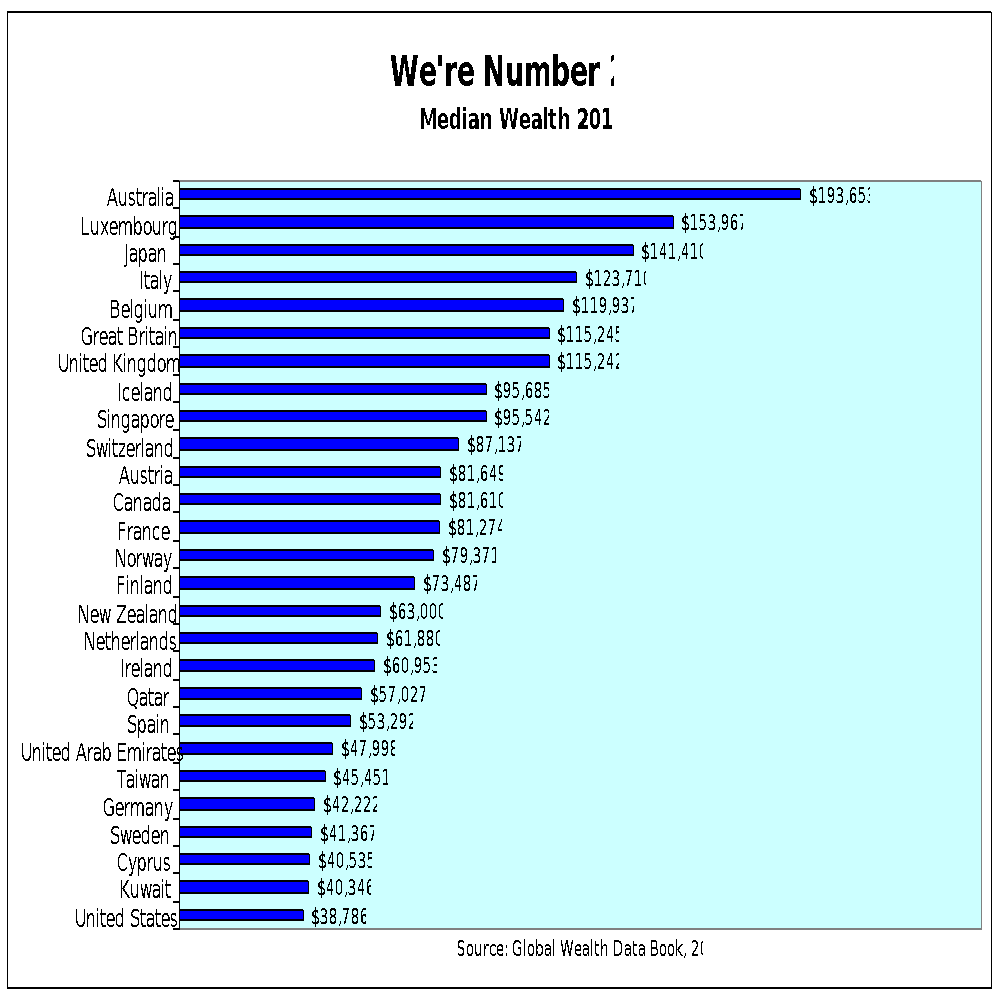
Our middle class is falling further and further behind in comparison to the rest of the world. We keep hearing that America is number one. Well, when it comes to middle-class wealth, we're number 27. 

The most telling comparative measurement is median wealth (per adult). It describes the amount of wealth accumulated by the person precisely in the middle of the wealth distribution—50 percent of the adult population has more wealth, while 50 percent has less. You can't get more middle than that.

Wealth is measured by the total sum of all our assets (homes, bank accounts, stocks, bonds etc.) minus our liabilities (outstanding loans and other debts). It the best indicator we have for individual and family prosperity. While the never-ending accumulation of wealth may be wrecking the planet, wealth also provides basic security, especially in a country like ours with such skimpy social programs. Wealth allows us to survive periods of economic turmoil. Wealth allows our children to go to college without incurring crippling debts, or to get help for the down payment on their first homes. As Billie Holiday sings, "God bless the child that's got his own." 

Well, it's a sad song. As the chart below shows, there are 26 other countries with a median wealth higher than ours (and the relative reduction of U.S. median wealth has done nothing to make our economy more sustainable).
Why?

Here's a starter list:

  • We don't have real universal healthcare. We pay more and still have poorer health outcomes than all other industrialized countries. Should a serious illness strike, we also can become impoverished.

  • Weak labor laws undermine unions and give large corporations more power to keep wages and benefits down. Unions now represent less than 7 percent of all private sector workers, the lowest ever recorded.

  • Our minimum wage is pathetic, especially in comparison to other developed nations [3]. (We're # 13.) Nobody can live decently on $7.25 an hour. Our poverty-level minimum wage puts downward pressure on the wages of all working people. And while we secure important victories for a few unpaid sick days, most other developed nations provide a month of guaranteed paid vacations as well as many paid sick days.

  • Wall Street is out of control. Once deregulation started 30 years ago, money has gushed to the top as Wall Street was free to find more and more unethical ways to fleece us. 

  • Higher education puts our kids into debt. In most other countries higher education is practically tuition-free. Indebted students are not likely to accumulate wealth anytime soon. 

  • It's hard to improve your station in life if you're in prison, often due to drug-related charges that don't even exist in other developed nations. In fact, we have the largest prison population in the entire world, and we have the highest percentage of minorities imprisoned. “In major cities across the country, 80% of young African Americans now have criminal records” (from Michelle Alexander's 2010 book, The New Jim Crow: Mass Incarceration in the Age of Colorblindness).

  • Our tax structures favor the rich and their corporations that no longer pay their fair share. They move money to foreign tax havens, they create and use tax loopholes, and they fight to make sure the source of most of their wealth—capital gains—is taxed at low rates. Meanwhile the rest of us are pressed to make up the difference or suffer deteriorating public services.

  • The wealthy dominate politics. Nowhere else in the developed world are the rich and their corporations able to buy elections with such impunity.

  • Big Money dominates the media. The real story about how we're getting ripped off is hidden in a blizzard of BS that comes from all the major media outlets...brought to you by....

  • America encourages globalization of production so that workers here are in constant competition with the lower-wage workers all over the world as well as with highly automated techonologies.

Is there one cause of the middle-class collapse that rises above all others?

Yes. The International Labor organization produced a remarkable study (Global Wage Report 2012-13) [4] that sorts out the causes of why wages have remained stagnant while elite incomes have soared. The report compares key causal explanations like declining bargaining power of unions, porous social safety nets, globalization, new technologies and financialization. 

Guess which one had the biggest impact on the growing split between the 1 percent and the 99 percent?

Financialization!  

What is that? Economist Gerald Epstein offers us a working definition [5]:

"Financialization means the increasing role of financial motives, financial markets, financial actors and financial institutions in the operation of the domestic and international economies."

This includes such trends as:

  • The corporate change during the 1980s to make shareholder value the ultimate goal.

  • The deregulation of Wall Street that allowed for the creation of a vast array of new financial instruments for gambling.

  • Allowing private equity firm to buy companies, load them up with debt, extract enormous returns, and then kiss them goodbye.

  • The growth of hedge funds that suck productive wealth out of the economy.

  • The myriad of barely regulated world financial markets that finance the globalization of production, combined with so-called "free trade" agreements.

  • The increased share of all corporate profits that go to the financial sector.

  • The ever increasing size of too-big-to-fail banks.

  • The fact that many of our best students rush to Wall Street instead of careers in science, medicine or education.

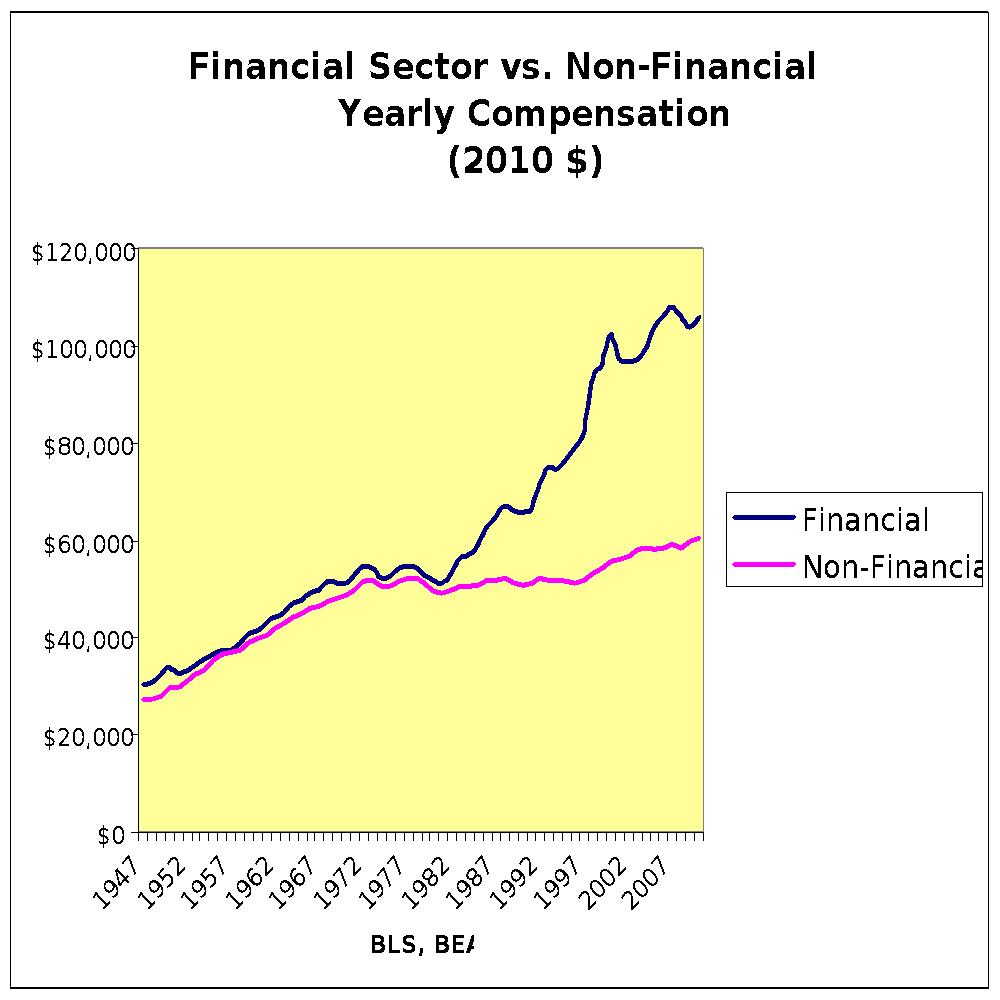
In short, financialization is when making money from money becomes more important that providing real goods and services. Here's a chart that says it all. Once we unleashed Wall Street, their salaries shot up, while everyone else's stood still.
Do we still know how to fight!

The carefully researched ILO study provides further proof that Occupy Wall Street was right on the money. OWS succeeded (temporarily), in large part, because it tapped into the deep reservoir of anger toward Wall Street felt by people all over the world. We all know the financiers are screwing us.

Then why didn't OWS turn into a sustained, mass movement to take on Wall Street?

One reason it didn't grow was that the rest of us stood back in deference to the original protestors instead of making the movement our own. As a result, we didn't build a larger movement with the structures needed to take on our financial oligarchs. And until we figure out how to do just that, our nation's wealth will continue to be siphoned away. 

Our hope, I believe, lies in the young people who are engaged each day in fighting for the basic human rights for all manner of working people—temp workers, immigrants, unionized, non-union, gays, lesbians, transgender—as well as those who are fighting to save the planet from environmental destruction. It's all connected.

At some point these deeply committed activists also will understand that financialization both here and abroad stands in the way of justice and puts our planet at risk. When they see the beast clearly, I am confident they will figure out how to slay it. 

The sooner, the better.


Source URL: http://www.alternet.org/economy/americas-middle-class-27th-richest

Links:
[1] http://www.alternet.org
[2] http://www.alternet.org/authors/les-leopold
[3] http://en.wikipedia.org/wiki/List_of_minimum_wages_by_country
[4] http://www.ilo.org/wcmsp5/groups/public/---dgreports/---dcomm/---publ/documents/publication/wcms_194843.pdf
[5] http://www.peri.umass.edu/fileadmin/pdf/programs/globalization/financialization/chapter1.pdf
[6] http://www.alternet.org/tags/middle-class
[7] http://www.alternet.org/%2Bnew_src%2B

Read More...

Wednesday, April 24, 2013

Speaking Truth about Violence: The Deeper Reality Behind Terror, Ours and Theirs

By Harry Targ

Progressive America Rising via Diary of a Heartland Radical

Establishing causal connections between “variables” and violence is a form of mystification. The reality of this world is that of grotesque inequalities in wealth, power, respect for humankind and the environment, a world awash in instrumentalities of death, and a global culture that celebrates it. Recent reports from the World Bank and the World Economic Forum (of all places) document the continuing and growing inequalities in wealth and income on a worldwide basis. Could it be a surprise that seemingly indiscriminate acts of violence occur all across the globe? Only a humane global movement for fundamental change can radically transform the world we live in but movements of protest can make constructive changes along the way (Harry Targ, Facebook, April 23, 2013).

Each violent tragedy in the United States brings an outpouring of wrenching and “expert” analyses of what was behind the acts that led to so much pain and suffering. Most of the soul-searching about tragedies from Arizona, to Colorado, to Connecticut, to Boston is about domestic events (the repeated killings of Iraqis, Afghan peoples, Pakistanis, Yemenis and others generate much less empathy). Explanations usually involve deranged “others,” usually poor “others,” “others” of color, and “others with fundamentalist religious beliefs.” Their crimes are described as perpetrated against victims who are the “normal” people. Make no mistake about it, violence against any individuals, communities, and nations must be opposed, even among those, who in the end are the root cause of it. But we need to be clear about the economic, social, political, cultural and military/police context in which violence occurs. And, in no small measure, violence itself is celebrated in the societies where it is most prevalent.

Peace researchers have written about “direct,” “cultural,” and “structural” violence for years. While each of these is seen as having its own characteristics and causes for the most part analysts regard the three as inextricably interconnected. Direct violence refers to physical assault, shooting, bombing, gassing, and torture. It is about killing people. Cultural violence refers to dominant cultures whose apparatuses, such as the media and laws, portray their own institutions and values as superior to others and rituals that seek to honor the violence engaged in by one’s own country or group while demeaning other countries or groups. What is most vicious about cultural violence is its effort to make the victimized groups hate themselves.

Structural violence occurs when economic, political, cultural and military institutions create relationships in which some human beings gain disproportionately from the labor, the talents, and the pain and suffering of others. Structural violence is institutionalized violence most often organized around class exploitation, racism, and patterns of gendered forms of domination and subordination. The key concepts that shape efforts to understand the causes and effects of structural violence are class, race, and gender.

Read More...

Thursday, March 14, 2013

Progressive 'Back to Work' Budget Wins Praise for Anti-Austerity Approach

'A reminder that we don’t need to cut teachers and school lunches when we can eliminate wasteful giveaways to fossil fuel corporations.'  Watch Rep. Keith Ellison introduce the budget here:

By Jon Queally
Progressive America Rising via CommonDreams.org

March 14, 2013 - In the midst of ongoing hysteria about a 'non-existent deficit crisis' in Washington, the Congressional Progressive Caucus on Wednesday unveiled an alternative approach to destructive austerity economics by releasing their 'Back to Work Budget' plan for 2014.

Pushing back specifically on the dominant talking point of inside-the-Beltway elites, the budget challenges the idea that cutting programs, reducing corporate tax rates, and slashing investments is a pathway to economic prosperity. Its proponents argue the US does not have "a deficit crisis"—as those pushing for steep cuts suggest—but rather, "a jobs crisis."

Presented by CPC co-chairs Reps. Raúl M. Grijalva and Keith Ellison and backed by members of the caucus' Budget Task force—Reps. Jim McDermott, Jan Schakowsky, Barbara Lee and Mark Pocan—the plan describes how smart investments, not deep cuts to key programs, would create almost 7 million jobs over the first year of its implementation.

“Americans face a choice,” Grijalva and Ellison said. “We can either cut Medicare benefits to pay for more tax breaks for millionaires and billionaires, or we can close outdated tax loopholes and invest in jobs. We choose investment.”

They continue:

    The Back to Work Budget invests in America’s future because the best way to reduce our long-term deficit is to put America back to work. In the first year alone, we create nearly 7 million American jobs and increase GDP by 5.7%. We reduce unemployment to near 5% in three years with a jobs plan that includes repairing our nation’s roads and bridges, and putting the teachers, cops and firefighters who have borne the brunt of our economic downturn back to work. We reduce the deficit by $4.4 trillion by closing tax loopholes and asking the wealthy to pay a fair share. We repeal the arbitrary sequester and the Budget Control Act that are damaging the economy, and strengthen Medicare and Medicaid, which provide high quality, low-cost medical coverage to millions of Americans when they need it most. This is what the country voted for in November. It’s time we side with America’s middle class and invest in their future.

Received as a breath of fresh air of economic sanity, the plan was praised by a variety of individuals and groups.

Read More...

Tuesday, January 22, 2013

Global Capital Looking to ‘Global Green New Deal’ for Climate and Other Bailouts

Editors Note: The key phrase below is ‘potential backers of low-carbon projects.’ From the left, there is no reason these can’t be public ownership projects or worker-owned coops—but it will take a fight.

Davos Call for $14 Trillion 'Greening' of Global Economy

Political and business leaders warned of need to ensure sustainable growth

By Tom Bawden
SolidarityEconomy.net via The Independent - UK

Jan 22 2013 - An unprecedented $14trn (£8.8trn) greening of the global economy is the only way to ensure long-term sustainable growth, according to a stark warning delivered to political and business leaders as they descended on the World Economic Forum in Davos yesterday.

Only a sustained and dramatic shift to infrastructure and industrial practices using low-carbon technology can save the world and its economy from devastating global warming, according to a Davos-commissioned alliance led by the former Mexican President, Felipe Calderon, in the most dramatic call so far to fight climate change on business grounds.

This includes everything from power generation, transport, and buildings to industry, forestry, water and agriculture, according to the Green Growth Action Alliance, created at last year's Davos meeting in Mexico.

The extra spending amounts to roughly $700bn a year until 2030 and would provide a much-needed economic stimulus as well as reduce the costs associated with global warming further down the line, said Mr Calderon, who leads the alliance.

It is better to try to pre-empt events like Hurricane Sandy, which cost $50bn, by keeping a lid on global warming, concluded the report, researched by the Accenture consultancy.

Mr Calderon, whose six-year term as Mexican President ended in November, said: "It is clear that we are facing a climate crisis with potentially devastating impacts on the global economy.

"Greening global economic growth is the only way to satisfy the needs of today's population and up to 9 billion people by 2050, driving development and wellbeing while reducing greenhouse gas emissions and increasing natural resource productivity."

Read More...

Sunday, December 23, 2012

Class War Redux: How the American Right Embraced Marxist struggle

Neither accident nor gaffe, Romney's '47%' remark was a declaration of war on a proletariat of feckless moochers

By Rick Wolff
Progressive America Rising via The Guardian, UK

Conservatives and Republicans used to keep quiet and private about their views on classes and class war in the United States. They ceded those terms to leftists and then denounced their use. The US was, they insisted, a mostly "classless" society, civilization's pinnacle achievement. We were a vast majority of wondrously comfortable and secure consumers.

Workers or capitalists, like classes, were antiquated, disloyal, and irrelevant concepts. True, a few fabulously rich people were visible (likely, film or sports celebrities or "entrepreneurial innovators"): their antics and luxuries were fun to mimic, admire, or deplore. An annoying and assuredly small underclass of the poor also existed: likely, persons "destroyed" by drugs or alcohol.

However, over recent decades, that approach has given way to a harsher view of US society, and the world beyond. At first, in their homes, country clubs, and unguarded moments with friends, conservatives and Republicans redefined their prime political enemy as the "moochers". Those people – Republican presidential nominee Mitt Romney called them "the 47%" always voting Democrat – depend on government handouts, and vote accordingly to secure those handouts.

Moochers include welfare recipients, the poor receiving Medicaid, students getting subsidized college loans, illegal immigrants, and, sometimes, also those "entitled" to get social security and Medicare benefits. They are all society's real "exploiters", using government to tax the other 53% of the people for the funds doled out to the 47%.

Read More...

Tuesday, April 10, 2012

Anti-Austerity: The Progressive Majority Option

A Budget to Rebuild America:

Now Elect a Congress to Pass It.

Editorial, The Nation

April 4, 2012 - Representative Paul Ryan and Mitt Romney kept relatively straight faces as they used their first campaign swing together, on the eve of the primary in Ryan’s home state of Wisconsin, to celebrate the “courage” of their austerity budget. That was no small task, as there is nothing more comic than “corporations are people, my friend” conservatives suggesting that it requires fortitude to propose tax cuts for the rich and a restructuring of Medicare, Medicaid and Social Security that would steer trillions toward insurance firms and Wall Street speculators.

What’s truly comic, though, is the notion that Ryan’s plan is intended to cut the debt. He admits, albeit quietly, that under his scheme it would take decades to get the government’s fiscal house in order. But that’s not the point. If a Romney/­Ryan administration (yes, Ryan now says he would consider accepting a place on the GOP ticket) were to enact the House Budget Committee chair’s plan, it would make the wealthy much wealthier while dramatically expanding the “shared sacrifice” of working Americans, the elderly and the disabled. President Obama aptly described it as “nothing but thinly veiled social Darwinism.”

Ryan’s agenda is better understood as the latest variation on GOP schemes to redistribute wealth upward. But there’s a new willingness among a growing number of Democrats—perhaps spurred by the spirit of Occupy Wall Street and the 99 percent movements—to counter the austerity lie. President Obama’s budg­et, which like the Ryan plan is more an election-year manifesto than a fiscal outline, is a step in the right direction, with proposed tax hikes for the wealthy, respect for entitlement programs and a gentle embrace of new stimulus spending. But the best proposals have been put forth by the Congressional Progressive Caucus and Senator Tom Harkin.

Both the CPC’s “Budget for All”  and Harkin’s “Rebuild America Act” recognize that the logical starting point in balancing budgets is to ask the wealthiest to pay their share. To that end, the CPC budget ends tax cuts for the top 2 percent; creates new brackets for millionaires and billionaires (including adopting the Buffett Rule); eliminates preferential treatment for capital gains and dividends; abolishes welfare for oil, gas and coal companies; and eliminates loopholes that allow businesses to dodge taxes. Both proposals suggest a financial transactions tax not just to raise revenues but to clamp down on Wall Street speculation.

This approach is a nonstarter with Congressional Republicans and also with too many Democrats, perhaps in part because the corporate media have mostly ignored the progressive alternatives. But numerous surveys show that Americans prefer taxing the rich over cutting Social Security and Medicare. They also support investment in infrastructure and job creation. That should be a lesson for Democrats this election year: the winning alternative to Romney/Ryan austerity is not kinder, gentler Democratic austerity. As AFL-CIO president Richard Trumka says, it’s smart economics and smart politics to demand that “shared sacrifice start at the top—with Wall Street and the wealthiest Americans.” 

In this election season, progressives must highlight the stark differences between Ryan’s budget and the alternatives offered by the CPC and Harkin. We must not merely reject the false promises and cruel calculations of Romney/Ryan austerity. We must elect a Congress that demands accountability, taxes fairly, defends the safety net and spends to rebuild America.

Read More...

Thursday, August 11, 2011

‘My City of Ruins’ from Bruce Springsteen, Telling It Like It Is…Pass it on!


It's time for a Main Street Contract for the American People. National Nurses United has embarked on a campaign to reverse national priorities and policies that have placed the interests of Wall Street over the crisis facing American families today. The goal is to chart a new contract for the American people — for a better life today and a more secure future for our children and future generations. www.mainstreetcontract.org

Read More...

Friday, April 15, 2011

Scorecards & Players: Political Economy for 2012

Graphic: Milton Friedman of the ‘Chicago School’

What is Neoliberalism?

A Brief Definition for Activists

By Elizabeth Martinez and Arnoldo Garcia
National Network for Immigrant and Refugee Rights

"Neo-liberalism" is a set of economic policies that have become widespread during the last 25 years or so. Although the word is rarely heard in the United States, you can clearly see the effects of neo-liberalism here as the rich grow richer and the poor grow poorer.
"
Liberalism" can refer to political, economic, or even religious ideas. In the U.S. political liberalism has been a strategy to prevent social conflict. It is presented to poor and working people as progressive compared to conservative or Rightwing. Economic liberalism is different. Conservative politicians who say they hate "liberals" -- meaning the political type -- have no real problem with economic liberalism, including neoliberalism.
"
Neo" means we are talking about a new kind of liberalism. So what was the old kind? The liberal school of economics became famous in Europe when Adam Smith, an Scottish economist, published a book in 1776 called THE WEALTH OF NATIONS. He and others advocated the abolition of government intervention in economic matters. No restrictions on manufacturing, no barriers to commerce, no tariffs, he said; free trade was the best way for a nation's economy to develop. Such ideas were "liberal" in the sense of no controls. This application of individualism encouraged "free" enterprise," "free" competition -- which came to mean, free for the capitalists to make huge profits as they wished.

Read More...

Friday, March 11, 2011

One Picture, One Thousand Words: The Right’s Wacko Priorities

We Are Not 'Broke,' We Just Need Progressive Tax Reform

Class Warfare, Illustrated

or Why We Need a Campaign to Turn Priorities Around

Read More...

Thursday, March 3, 2011

Jobs for All Now! Get Your Member of Congress to Sign On to HR 870 Full Employment Bill

Help Put America

Back to Work:

Cosponsor H.R. 870


A Message From:

The Hon. John Conyers, Jr.

Bill: H.R. 870
Date: 3/3/2011

Let’s Put America Back To Work:
Become a Cosponsor of H.R. 870
'The Humphrey-Hawkins 21st Century
Full Employment & Training Act'


Dear Colleague,


In order to expand job opportunities for Americans who have been unable to find work during this period of unacceptably high unemployment, I recently reintroduced H.R. 870, the “Humphrey-Hawkins 21st Century Full Employment and Training Act.”  This bill would establish a comprehensive and innovative federal and local government job creation and training program that would create millions of new jobs for the nation’s unemployed.  


Under H.R. 870, the Department of Labor would work collaboratively with local and state governments, non-profits, and the private-sector to fund community based “fast track” jobs. This work could include renovating housing and schools, weatherizing homes, fixing our aging infrastructure, expanding access to broadband and wireless internet, neighborhood beautification projects, or other community initiatives in the health and education sectors. This direct job creation effort would be coupled with a significant increase in funding for job training programs authorized by the Workforce Investment Act. Funds will automatically continue to be disbursed from the Act’s Full Employment and Training Trust Fund until a level of “full employment” is reached in the economy.


Additionally, because we are living in a period when concerns about government debt loom large in many minds, my legislation will be fully funded by a tax on Wall Street speculation and will not add a dime to the federal debt.  Wall Street was responsible for the financial crisis that began in 2008 and continues to affect us today.  Having already received significant assistance from the federal government, it is only fair that Wall Street now pay Main Street back by helping put America back to work.   


If you would like to cosponsor H.R. 870, please contact Michael Darner (michael.darner@mail.house.gov) at (202) 225-5126.


Sincerely,
John Conyers, Jr.
Member of Congress

Read More...

Friday, January 7, 2011

Hard Times in Graphs and Numbers

Summing up the Economic Crisis

(Click here to make larger)

Read More...

My Zimbio Add to Technorati Favorites Locations of visitors to this page EatonWeb Blog Directory