Showing posts with label Progressives. Show all posts

Tuesday, February 24, 2015

'People Are Really Getting Angry': How Bernie Sanders Just Electrified Iowa — And What It Means for 2016

At an under-the-radar town hall in Des Moines, Sanders had the crowd begging for more. Here's why it matters

By Robert Leonard
Progressive America Rising via Salon.com

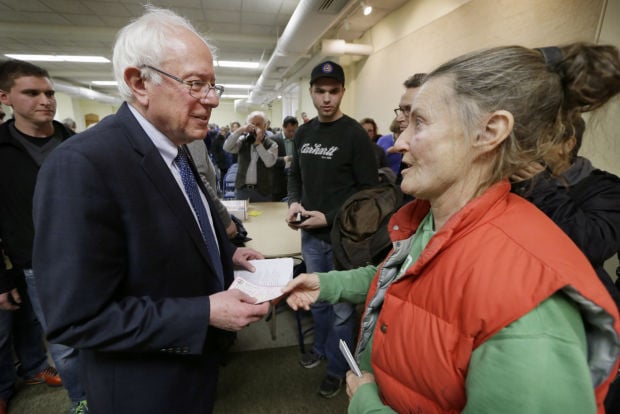
Feb 24, 2015 - DES MOINES — Bernie Sanders has neckties older than most of his audience at last Friday’s Drake University Town Hall in Des Moines. Yet the age differential didn’t matter. His college-age audience loved him. Organized by Drake progressive students, Sanders and his audience seemed to have a near telepathic connection. His issues are their issues, and if anything, they are more pissed off than he is.

Several Drake students set the stage for Sanders in brief topical introductions, laying waste to money in politics, Citizens United specifically, the reality and dangers of climate change, the importance of pay equity for women, immigration reform, and the crushing burden of the cost of college and debt. Then Bernie nailed it, touching on all of these topics and more.

Unlike the speeches at the recent Republican Iowa Freedom Summit, Sanders was long on ideas, and short on chest-thumping, fiery rhetoric. He also didn’t have an audience mostly old enough to vote when Ronald Reagan was running for president.

At first it was unclear who the bigger enemy of the people were to Sanders — the Kardashians or the Koch brothers.  The Kardashians, or rather our public fascination with them, represents America’s apathy. Sanders was clear that nothing progressive can happen until people start paying attention.  Sanders told his audience that Americans are getting screwed, and that we had better pay attention and get off our asses.

According to Sanders, our government is bought and paid for by the Koch brothers, and we are living in an oligarchy. He illustrated the point by reminding us of the recent announcement that the Kochs plan to spend $900 million on the next presidential election, when Obama and Romney each spent approximately $1 billion in 2012.  He feels that soon, they will have more power than either the Democratic or Republican parties, just because of their wealth and the leverage the 5-4 Supreme Court Citizens United decision gave them and other billionaires.

The question and answer session took an interesting turn when a stocky young man with the voice of a broadcasting major asked Sanders, “Will you run for president in 2016?”

If he had asked, “Are you going to run…” Sanders might have responded differently. “I don’t know yet,” would have been a good answer. But since he was asked, “Will you run…” Sanders apparently heard it as a request for him to run. 

“That’s a good question that you’ve asked,” Sanders said.  “Let me throw it back to you… do you think there is the support in this country?” To which the young man replied, “ I think I do. I do. I think there is the support out there … people are really getting angry about this income inequality, climate change…we’re tired of it.”  (Continued)

Read More...

Monday, December 1, 2014

Is The Democratic Party Relevant Anymore?


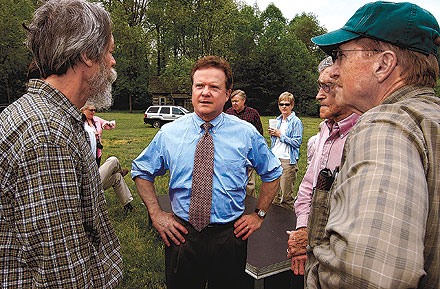
Former Senator Jim Webb on the Campaign Trail

(Or more background for Carl Davidson’s ‘Six Party System’ Thesis)

By Dave Johnson

Progressive America Rising via OurFuture.org

Nov 30, 2014 - Many Democrats examining what happened in the 2014 midterms are asking “what did the voters want?” But the right question is why did only 36.4 percent of potential voters bother to register and vote? Obviously Democrats did not give those voters a good enough reason to take the trouble. Is the Democratic Party relevant anymore?

“New Coke” Democrats

In 1985 Coca-Cola was the market leader, but Pepsi was gaining market share. Coca-Cola’s executives panicked and reformulated its flavor to taste like the more-sugary Pepsi. But Pepsi drinkers already drank Pepsi and Coca-Cola drinkers were left with no brand that they liked. If this sounds like an analogy to the Democratic Party consultants who keep urging Democratic candidates and politicians to be more like Republicans, that’s because it is.

Democrats were considered the majority party from the time of Roosevelt’s New Deal until the 1980s. All they had to do to win was to get a high enough voter turnout. Democratic operations were more about Get Out The Vote (GOTV) than giving people reasons to vote for Democrats instead of Republicans. They just assumed most people agreed with them – because most people agreed with them. But that time has passed.

In the 1970s corporations and conservatives launched a major marketing push, establishing a network of PR “think tanks” that pushed a neoliberal economic line. Since the mid-1970s Americans have been subjected to a constant drumbeat through all purchasable and infiltratable information channels – even a whole TV network that blasts out right-wing propaganda 24/7/12/365 – all constantly repeating a professionally-crafted propaganda narrative that conservatives and their values are good and “liberals” and their values are bad.

Instead of responding and countering this, most Democratic candidates and officeholders instead tried moving to where their pollsters perceived the pubic to be on an imagined political spectrum. Conservatives pushed the public right, no one responded to the propaganda, Democrats chased the inevitable result. In this environment the country’s politics could only shift rightward – and voters who did not want to vote for “Pepsi-like” candidates to the right of them stopped turning out.

So corporate, neo-liberal policies came to dominate our economy. “Free trade”, anti-union, monopolistic anti-democracy policies have killed wage growth and government programs for regular, working people and regular, working people have responded by turning away from the party that was supposed to be watching out for them.

Read More...

Saturday, November 15, 2014

Elizabeth Warren: It’s Time to Work on America’s Agenda


(J. David Ake/AP)

By Elizabeth Warren

Op-Ed, Washington Post

Elizabeth Warren, a Democrat, represents Massachusetts in the Senate.

Nov 7, 2014 - There have been terrible, horrible, no good, very bad Election Days for Democrats before — and Republicans have had a few of those, too. Such days are always followed by plenty of pronouncements about what just changed and what’s going to be different going forward.

But for all the talk of change in Washington and in states where one party is taking over from another, one thing has not changed: The stock market and gross domestic product keep going up, while families are getting squeezed hard by an economy that isn’t working for them.

The solution to this isn’t a basket of quickly passed laws designed to prove Congress can do something — anything. The solution isn’t for the president to cut deals — any deals — just to show he can do business. The solution requires an honest recognition of the kind of changes needed if families are going to get a shot at building a secure future.

It’s not about big government or small government. It’s not the size of government that worries people; rather it’s deep-down concern over who government works for. People are ready to work, ready to do their part, ready to fight for their futures and their kids’ futures, but they see a government that bows and scrapes for big corporations, big banks, big oil companies and big political donors — and they know this government does not work for them.

The American people want a fighting chance to build better lives for their families. They want a government that will stand up to the big banks when they break the law. A government that helps out students who are getting crushed by debt. A government that will protect and expand Social Security for our seniors and raise the minimum wage.

Americans understand that building a prosperous future isn’t free. They want us to invest carefully and prudently, sharply aware that Congress spends the people’s money. They want us to make investments that will pay off in their lives, investments in the roads and power grids that make it easier for businesses to create good jobs here in America, investments in medical and scientific research that spur new discoveries and economic growth, and investments in educating our children so they can build a future for themselves and their children.

Before leaders in Congress and the president get caught up in proving they can pass some new laws, everyone should take a skeptical look at whom those new laws will serve. At this very minute, lobbyists and lawyers are lining up by the thousands to push for new laws — laws that will help their rich and powerful clients get richer and more powerful. Hoping to catch a wave of dealmaking, these lobbyists and lawyers — and their well-heeled clients — are looking for the chance to rig the game just a little more.

But the lobbyists’ agenda is not America’s agenda. Americans are deeply suspicious of trade deals negotiated in secret, with chief executives invited into the room while the workers whose jobs are on the line are locked outside. They have been burned enough times on tax deals that carefully protect the tender fannies of billionaires and big oil and other big political donors, while working families just get hammered. They are appalled by Wall Street banks that got taxpayer bailouts and now whine that the laws are too tough, even as they rake in billions in profits. If cutting deals means helping big corporations, Wall Street banks and the already-powerful, that isn’t a victory for the American people — it’s just another round of the same old rigged game.

Yes, we need action. But action must be focused in the right place: on ending tax laws riddled with loopholes that favor giant corporations, on breaking up the financial institutions that continue to threaten our economy, and on giving people struggling with high-interest student loans the same chance to refinance their debt that every Wall Street corporation enjoys. There’s no shortage of work that Congress can do, but the agenda shouldn’t be drawn up by a bunch of corporate lobbyists and lawyers.

Change is hard, especially when the playing field is already tilted so far in favor of those with money and influence. But this government belongs to the American people, and it’s time to work on America’s agenda. America is ready — and Congress should be ready, too.

Read More...

Wednesday, November 12, 2014

Progressive Dems: Obama Should Push Economic Executive Actions After Midterm Losses

By Dave Jamieson

Progressive America Rising via Huffington Post

WASHINGTON, Nov. 10, 2014 -  Republican leaders have warned President Barack Obama that pursuing more executive actions after last week's midterm drubbing would be like playing with fire. But Rep. Raul Grijalva (D-Ariz.), co-chair of the Congressional Progressive Caucus, said on Monday that unilateral action by the president on economic issues is more necessary than ever.

"The president is in a pivotal position to go assertively with executive orders to create a political balance and an economic balance," Grijalva told reporters on a conference call. "I'm one member that urges them to use that as a balancing tool and a leadership tool in these next two years."

Grijalva and his fellow caucus co-chair, Rep. Keith Ellison (D-Minn.), are putting their weight behind two proposals in particular: one executive order that would give federal contracting preference to firms that pay a living wage of $15 and provide basic benefits to workers, and another guaranteeing that contractors wouldn't interfere with worker efforts to unionize. Branded as "More Than the Minimum," the proposals are being pushed by Good Jobs Nation, a labor group backed by the Change to Win union federation, and other progressive allies.

Ellison and Grijalva, along with Good Jobs Nation, already have a couple of executive-action victories under their belts. They successfully pressured the White House to institute two executive actions that were signed by the president earlier this year -- one setting a minimum wage of $10.10 for federal contractors, and another that would effectively bar firms that have committed wage theft against their workers from receiving federal contracts.

Read More...

Thursday, July 17, 2014

Memo to Obama: Avoid Splinters in Iraq, Syria

Jim McGovern (D-MA) pushing war powers vote

By Tom Hayden

Beaver County Peace Links

July 15, 2014 - Congressional support for a War Powers authorization looms as the only opportunity for the US to avoid another self-inflicted wound in Iraq and Syria.

The fifteen-day deadline provides an opportunity for anti-war groups to exert public pressure against any escalation, and a wrenching deadline for Congress to end its dickering and denial.

The best that can be expected is a face-saving bipartisan formula for avoiding a quagmire while minimizing the political cycle of blame. The difficulty will be defining a formula that might yet patch together the Sunni "humpty" with the Shiite "dumpty". If that is possible at all, the interim solution will take the same threat by John Kerry and the Western alliance to stop funding sectarianism, which has worked for the moment in Afghanistan. A no-fault divorce of Kurds, Sunnis, and Shiites seems out of the question, meaning an expansion of war.

The most important advice President Barack Obama should heed in Iraq and Syria is to avoid splinters. When these tiny barbed slivers cut into flesh, they can be painful to remove completely. Patience and soapy warm water are recommended, which translates into diplomacy as the equivalent of medicine.

ISIS is an Islamic splinter ready to pierce American flesh. The responsible US approach should be hands-off. As predicted here, the ISIS offensive will stall as it approaches Shiite strongholds in Baghdad and further south. Tensions within ISIS will increase. Instead of funding and arming the sectarian al-Maliki regime, the best American approach is to threaten a cutoff in funding unless al-Maliki abides by a genuine power-sharing arrangement, presumably including his resignation. As frequently occurs, America's "client" (in this case al-Maliki) turns the tables (on his "master") with confidence that the US will not pull the plug. 

ISIS is only the latest example of how wrongheaded US military intervention often creates exactly the enemies they claim to be preventing. It is established fact, except among the neo-con crackpots, that al-Qaeda did not even exist in Iraq until the US invasion created the conditions for its birth. Then US Special Ops went to war in Iraq against al-Qaeda in league with Sunni "Awakening" forces in 2007, when that version of AQ was considered too extreme even for the disenfranchised Sunni tribes in Anbar Province. The apparent "defeat" of that al-Qaeda by the US and the tribes spawned a splinter insurgency, which has become ISIS in Iraq.

Meanwhile, other splinters were breaking loose within the Syrian Sunni insurgency against Assad. While the US tried to pick and choose among competing "free Syria" contenders, the al-Qaeda leader Ayman al-Zawahiri was expelling the splinter group which became ISIS. The grounds for the split were two-fold: that the ISIS violence was too extreme and indiscriminate, and Zawahiri wanted ISIS to focus on Iraq and leave the Nusra Front to deal with Syria. The splintering continued with the formation of the Army of Islam, whose thousands of fighters have been battling ISIS on the same issues of excessive brutality. By one estimate, seven thousand fighters have been killed in clashes between these Syrian splinter groups since January.

Air strikes by the US, combined with any escalation of ground forces, under whatever label, would be a key factor in unifying these insurgent splinters who otherwise are at each other's throats. The splinters thus lodged in America's flesh will be hard to remove any time soon.

****************

McGovern Demands War Powers Vote in Two Weeks

July 11 - Representative Jim McGovern (D-MA) today introduced a measure requiring a House vote on Iraq under the War Powers Resolution, forcing the Republican leadership to take action within fifteen days or face an up-or-down vote, which might curb the administration's escalating military intervention in the civil war. 

"We are trying to signal to the House leadership that we have a constitutional responsibility on questions of war and peace," McGovern said this morning. "It's all to easy to let things drift. When Congress goes on recess in August, there could be more American troops authorized, or a US bombing. John Boehner doesn't want a debate on Iraq. He's rather sit back. There's a fear that a majority will say they don't want a war."

McGovern's measure is co-authored by Rep. Barbara Lee (D-CA) and Rep. Walter Jones (R-NC). Lee has been circulating a House letter calling for application of the War Powers Resolution. The new measure contains a trigger that is hard to avoid. McGovern is seeking co-authors on his proposal while the clock is running. Lee, along with Republican Rep. Scott Rigell, has gathered nearly one hundred signers on a House letter urging compliance with the War Powers Resolution

--

Sources:

McGovern's House Floor Speech: https://www.youtube.com/watch?v=K3VZGjxD7SE&feature=youtu.be

The Resolution: http://mcgovern.house.gov/sites/mcgovern.house.gov/files/McGovern%20HCON%20RES%20105.pdf

Read More...

Wednesday, August 28, 2013

Movement Envy: Chicago Looks at North Carolina

Protesters rally during "Moral Monday" demonstrations at Halifax Mall near the General Assembly in Raleigh, N.C., in July. More than 1,000 people have been arrested while protesting against policies being enacted by the North Carolina General Assembly. (AP Photo/Gerry Broome)

By Susan Klonsky

I admit it. We have a great movement here in Chicago, but still, I'm jealous of Mondays in North Carolina.

Reviving the spirit and moral compass of the Civil Rights Movement of the ‘60s, protest has become the Monday Lifestyle in NC.  People  put their Monday evening rallies on the calendar. “Mon. 5:30 pm:  Sit in, get arrested @ State Capitol.” It’s becoming sort of normal.

For the past 4 months in Raleigh, every Monday  is Moral Monday. Late in the day, as people get off work, they surround the Statehouse with rings of protesters. Mass arrests are scheduled, followed on Thursdays by well-organized press conferences by those arrested.  Every Monday the protests get larger—now exceeding 15,000 in Raleigh, with big rallies throughout the state. The movement is multiracial and has spread well beyond North Carolina’s capital out to the mountainous west of the state, to small towns and tiny hamlets.

Reverend Dr. William Barber

The leader of this movement is a Disciples of Christ minister, the Reverend Dr. William Barber III.  I had the pleasure of meeting Rev. Barber earlier this week. He is the latest in a bloodline of activist pastors who have fought racial segregation and its ugly siblings, poverty and violence, for generations. Rev. Barber, a giant of an orator, is the state chairman of the North Carolina NAACP. With the NAACP as its nucleus,  the Moral Monday Movement is an expansive coalition embracing an impressive number of organizations in all fields, labor unions, religious congregations, professional societies, and even fraternities and sororities. And they are on a roll.

“We’ve got a strategy. We never expected this thing to take off as it has. But we had to sit down and say, ‘where are we going with this?’” Barber explains. “We started off with one rally, and now we’re at the point of having 13 mass rallies in all 13 Congressional districts across the state. We’ve even had one of the county Republican party chairs renounce his own party,” as the result of the backward legislation the GOP has rammed through the North Carolina Legislature.

The Moral Monday folks have put their heads together and done the math. They’ve cooked up a plan for retaking the Democratic majority in the North Carolina Legislature and the state’s Congressional delegation. To accomplish these objectives will require a massive voter registration effort designed to boost the percentages of African American registered voters as well as a one-percent shift of white voters away from Republican candidates.

More than 1,000 arrests for civil disobedience.

The plan involves mass participation in voter education and mobilization. Unions and professional societies will play a big part, by having their members trained to register voters (and to deal with the new and exceptionally stringent, obstructive regulations about voter identification). “If each of us does 50 registrations, we can make our goal of 45,000 new voters,” Barber explains. “That’s why we must start now. It’s totally attainable.”

I asked Rev. Barber if he feels they can keep these Monday events going indefinitely. He explained that they are building for a few major events this winter. In particular, in December when the remaining major cutbacks to Medicaid in the state kick in, and again in January, he expects an uptick in mass protest against the attacks upon public education, social and health services, including reproductive rights, and state aid to the poor and unemployed.

Last month, Barber told us, the movement spread to some of the whitest, most heavily Republican parts of the state, where the Tea Party had until recently held sway. Now that people are beginning to experience the impact of budget slashing including removal of protections for teachers and other public employees, the picture is changing. “We were invited to speak up in rural Mitchell County, way up in the mountains,” Barber said, “and we found ourselves at a church way up there, in the evening, with at least a thousand people—an all white crowd—waiting for us.”

It used to be  Klu Klux country up there, and Reverend Barber admits he was somewhat apprehensive about what kind of reception he might receive.  He was greeted by the assembled joining together to sing Blessed be the tie that binds/Our hearts in Christian love.  “They were  fired up for Moral Monday.”

What brought them out, at least in part, Barber observed, was the attacks upon teachers. “They have 17 or 18 percent unemployment up there. And the schools are some of the biggest employers in these counties, and now they are having to lay off school personnel because of the state budget cuts to education. Plus, there is no more tenure or job security at all for them. A man got up at that meeting and declared, ‘When they hurt education, they really hurt us mountain people.’”

Moral Monday has lots of religious participants. But it is not a religious movement. “For me, this is a fight to uphold our deepest Constitutional, Biblical and faith values,” says Barber. It is many things to many people. At public meetings throughout the state, people testify to their worries, anger and intention to be part of the fight in North Carolina.

The issues draw them together:

Voting rights, health care, education, jobs and poverty. The movement stands in defense of  LGBT rights including marriage equality. How does Moral Monday deal with religion and religious differences? “We are tired of the Christian Right which is so wrong trying to dominate the moral high ground,” Barber explains. “We challenge them:  Are you really ready for a moral debate? Are you ready to defend what you have done?  Of course they don’t want to debate. It most certainly is a moral issue. Cutting people off from health care, from their jobs, taking food off their tables. They have no integrity and they hide from debate.”

The budget slashing and violations of basic civil rights are shaped by the ALEC agenda--the same ALEC which we protested less than 2 weeks ago in Chicago. The same ALEC which designed Florida’s murderous “Stand Your Ground” law.  These people are extremists, Barber emphasizes. Their policies are dangerous. And people are beginning to see them for what they are.

At the core of the Moral Mondays movement is a strong principle of anti-racism. It is impressive to witness this principle beginning to penetrate a broad swath of the population, as people come together to win back the rights that have been violated and denied.

Yes, we have a great movement here in Chicago, but I’m still a little jealous.

Read More...

Saturday, August 10, 2013

Vote Rush Holt: Don't Give Wall Street Banksters Another Senate Seat

Defend Social Security! Only a Few Days To Go Before The New Jersey Primary  

This week Blue America and Progressive Democrats of America (PDA) sent a joint letter to all our members asking them to support Rush Holt for the open New Jersey Senate seat.

The August 13 primary has 4 Democrats vying for the nomination-- Rush Holt and Frank Pallone, both progressive congressmen, General Assembly Speaker Sheila Oliver, a kind of boss-affiliated garden variety Democrat, and the Wall Street candidate, Newark Mayor Cory Booker. The special election itself will be held October 16. Digby penned the letter:

    Last April, just three months before he passed away, the ailing liberal lion Senator Frank Lautenberg issues a strong statement in opposition to proposed cuts to Social Security. He said: "We can't afford to further balance our books on the backs of middle-class families and seniors. The proposed cuts to Social Security benefits are a major problem that would hurt countless Americans.”

    Sadly, the man considered to be the front runner to succeed him, Newark mayor and media darling Cory Booker, isn't willing to hold that line. He said just this week that he'd consider raising the retirement age for younger people, a patented Republican dodge and a sure sign that he cannot be trusted to protect the Democratic Party's greatest achievement.

    But there is someone in the race who will protect Social Security and his name is Congressman Rush Holt.

    Holt not only opposes all cuts to our most important social insurance program, he is a co-sponsor of the Protecting and Preserving Social Security Act, which would expand Social Security benefits not cut them. Where Mayor Booker has said that he has "not formed an opinion" on a carbon tax, something which 41 Democratic Senators have already voted for, Rush Holt is card carrying scientist who strongly supports it.

    Where Mayor Booker thinks calling for repeal of the Patriot Act is "irresponsible", Rush Holt sponsored a bill in the House just this week to do just that. He said: "The executive branch’s groundless mass surveillance of Americans has turned our conception of liberty on its head. My legislation would restore the proper constitutional balance and ensure our people are treated as citizens first, not suspects.”

    Where Mayor Booker considers Wall Street a strong friend and ally, Rush Holt... doesn't.

    The last thing we need in the US Senate is another Wall Street friendly centrist with a propensity for government secrecy and a willingness to cut our most important social insurance programs. There are plenty of those already.

    In the upcoming primary, New Jersey can choose an establishment celebrity who plays a progressive on TV or it can choose a real progressive. We strongly believe the choice for progressives in this race is obvious and urge you support Congressman Rush Holt for US Senate. Please donate what you can and spread the word among your friends and acquaintances in New Jersey.

- See more at: http://downwithtyranny.blogspot.com/2013/08/less-than-two-weeks-to-go-before-new.html#sthash.ZBzLKQ0t.dpuf

Read More...

Sunday, May 19, 2013

Tossing Out the Little Cop of Cynicism in Our Brains


The Triumph of Progressivism: Graduation 2013 and 1968

By Robert Reich,

Robert Reich's Blog | Truthout Op-Ed

May 19, 2013 - Many of you soon-to-be college graduates are determined to make the world a better place. Some of you are choosing careers in public service or joining nonprofits or volunteering in your communities.

But many of you are cynical about politics. You see the system as inherently corrupt. You doubt real progress is possible.

“What chance do we have against the Koch brothers and the other billionaires?” you’ve asked me. “How can we fight against Monsanto, Boeing, JP Morgan, and Bank of America? They buy elections. They run America.”

Let me remind you: Cynicism is a self-fulfilling prophesy. You have no chance if you assume you have no chance.

“But it was different when you graduated,” you say. “The sixties were a time of social progress.”

You don’t know your history.

When I graduated in 1968, the Vietnam War was raging. Over half a million American troops were already there. I didn’t know if I’d be drafted. A member of my class who spoke at commencement said he was heading to Canada and urged us to join him.

Two months before, Martin Luther King Jr. had been assassinated. America’s cities were burning. Bobby Kennedy had just been gunned down.

George (“segregation forever”) Wallace was on his way to garnering 10 million votes and carrying five southern states. Richard Nixon was well on his way to becoming president.

America was still mired in bigotry.

I remember a classmate who was dating a black girl being spit on in a movie theater. The Supreme Court had only the year before struck down state laws against interracial marriage.

My entire graduating class of almost 800 contained only six young black men and four Hispanics.

I remember the girlfriend of another classmate almost dying from a back-alley abortion, because safe abortions were almost impossible to get.

I remember a bright young woman law school graduate in tears because no law firm would hire her because she was a woman.

I remember one of my classmates telling me in anguish that he was a homosexual, fearing he’d be discovered and his career ruined.

The environmental movement had yet not been born. Two-thirds of America’s waterways were unsafe for swimming or fishing because of industrial waste and sewage.

I remember rivers so polluted they caught fire. When the Cuyahoga River went up in flames Time Magazine described it as the river that “oozes rather than flows,” in which a person “does not drown but decays.”

In those days, universal health insurance was a pipe dream.

It all seemed pretty hopeless. I assumed America was going to hell.

And yet, reforms did occur. America changed. The changes didn’t come easily. Every positive step was met with determined resistance. But we became better and stronger because we were determined to change.

When I graduated college I would not have believed that in my lifetime women would gain rights over their own bodies, including the legal right to have an abortion. Or women would become chief executives of major corporations, secretaries of state, contenders for the presidency. Or they’d outnumber men in college.

I would not have imagined that eleven states would allow gays and lesbians to marry, and a majority of Americans would support equal marriage rights.

Or that the nation would have a large and growing black middle class.

It would have seemed beyond possibility that a black man, the child of an interracial couple, would become President of the United States.

I would not have predicted that the rate of college enrollment among Hispanics would exceed that of whites.

Or that more than 80 percent of Americans would have health insurance, most of it through government.

I wouldn’t have foreseen that the Cuyahoga River – the one that used to catch fire regularly – would come to support 44 species of fish. And that over half our rivers and 70 percent of bays and estuaries would become safe for swimming and fishing.

Or that some 200,000 premature deaths and 700,000 cases of chronic bronchitis would have been prevented because the air is cleaner.

Or that the portion of children with elevated levels of lead in their blood would have dropped from 88 percent to just over 4 percent.

I would not have believed our nation capable of so much positive change.

Yet we achieved it. And we have just begun. Widening inequality, a shrinking middle class, global warming, the corruption of our democracy by big money – all of these, and more, must be addressed. To make progress on these — and to prevent ourselves from slipping backwards — will require no less steadfastness, intelligence, and patience than was necessitated before.

The genius of America lies in its resilience and pragmatism. We believe in social progress because we were born into it. It is our national creed.

Which is to say, I understand your cynicism. It looks pretty hopeless.

But, believe me, it isn’t.

Not if you pitch in.

This piece was reprinted by Truthout with permission or license. It may not be reproduced in any form without permission or license from the source.


Robert Reich

ROBERT B. REICH, Chancellor’s Professor of Public Policy at the University of California at Berkeley, was Secretary of Labor in the Clinton administration. Time Magazine named him one of the ten most effective cabinet secretaries of the last century. He has written thirteen books, including the best sellers “Aftershock" and “The Work of Nations." His latest, "Beyond Outrage," is now out in paperback. He is also a founding editor of the American Prospect magazine and chairman of Common Cause.


    Show Comments

    Read More...

    Sunday, January 6, 2013

    ‘Flip the Script’ –Jobs over Deficits

    Job seekers waiting in line

    The Republican Lock on Congress

    By Bill Fletcher, Jr.
    Progressive America Rising via billfletcherjr.com

    There is a strategic question that faces progressives, one that is receiving increased attention.  Due to the 2010 elections and the Republican domination of state legislatures, Congressional Districts have been gerrymandered in order to guarantee a lack of any significant electoral challenges.  In other words, these Districts have Republican Congresspeople who are not worried about opposition.

    As we saw in the lead up to the ‘fiscal cliff’ negotiations/resolution, most Republicans felt no internal pressure to compromise.  It is quite likely that they will feel little pressure in their districts for at least ten years.  As a result the sort of pressure that they must feel must transcend their districts and actually be more at the societal level.  What this means is that while progressives absolutely need an independent electoral strategy that builds locally-based organizations capable of successfully running candidates for office–both inside and outside of the Democratic primary system–that is insufficient.

    In fact, it is the Occupy Movement that pointed us in the direction of the other leg of such a movement. What the Occupy Movement accomplished, among other things, was to change the social discourse.  Despite every effort by the mainstream media to dismiss the Occupy Movement it not only grew but forced the country to start to address the question of economic inequality.

    In the current context the implications should be clear.  If, for instance, we are to fight it out on the economy and specifically on unemployment, this will not happen on the basis of fights in the Republican Congressional Districts.  It will be a fight that we will have to take up in cities, including but not limited to state capitols, around the country.  It means social protests which are disruptive. 

    In order for this to happen we must actually re-train many social movement activists and thinkers in the lessons of the 1930s labor movement, the 1950s-1960s freedom movements (including but not limited to the Civil Rights Movement), the movement against the Vietnam War, and the work of the early environmental movement. 

    Occupy, in that sense, was onto something.  We must carry out a fight for space as part of the fight for power.  Land occupations, eviction blockades, boycotts, as well as mass demonstrations are all critical.  [Note: in fact, we need, right now, a series of REALLY mass marches for jobs.] In other words, the sort of pressure that needs to be brought about must be something that Republicans AND Democrats feel, and in fact, become a serious source of concern.

    Before we find ourselves wallowing in self-pity as we worry about the Republican ‘lock’, let’s rethink our strategy and tactics.  We may be able to flip the script, and sooner rather than in the distant future.

    Read More...

    Thursday, October 11, 2012

    Can We Defeat the Racist Southern Strategy in 2012?

    By Bob Wing*

    Progressive America Rising

    *Bob Wing has been an organizer since 1968 and was the founding editor of ColorLines magazine and War Times/Tiempo de Guerras newspaper. He lives in Durham, N.C. and can be contacted on Facebook. Thanks to Max Elbaum for his always insightful suggestions. This article was posted on Oct. 11, 2012.

    The 2012 election is a pitched battle with race at the center.

    It may not be “polite” to say this, but far from an era of “post racialism”, the United States is in a period of aggravated racial conflict. Though often denied and certainly more complex than the frontal racial confrontations of the past, race is the pivot of the tit-for-tat political struggle that has gripped the country for the past twelve years and, indeed, for decades prior.

    The modern era of this conflict jumped off with the white conservative backlash against the Voting Rights Act of 1965 and has been deepened by their decades-long fearful reaction to the dramatic change in the color of the U.S. that resulted from the civil rights-motivated immigration reform act of 1965.

    The conflict heated to a boil when white conservatives flatly rejected the legitimacy of the “premature” victory of our first Black president in 2008. Nearly 40 percent of Republicans are so enraged they cannot even admit that Obama is a U.S. citizen. Isn’t this really another way of saying they refuse to recognize a Black man as the president? Or perhaps it is the white conservatives’ modern day Dred Scott decision declaring Obama a Black man that has no rights that they are bound to respect?

    The bottom line is that we have now come to a point where voters of color are so numerous and so united behind Obama that, to be victorious, Mitt Romney must carry a higher percentage of the white vote than any modern Republican candidate has ever won. If recent trends among voters of color hold, he must carry about 63 percent of white voters. Not even Reagan won more than 61 percent.

    Read More...

    Tuesday, August 14, 2012

    What to Do in November, and Beyond

    The 2012 Elections Have Little To Do With Obama's Record … Which Is Why We Are Voting For Him

    The 2012 election will be one of the most polarized and critical elections in recent history.

    By Bill Fletcher, Jr. and Carl Davidson
    Progressive America Rising via Alternet.org

    August 9, 2012 - Let’s cut to the chase. The November 2012 elections will be unlike anything that any of us can remember.  It is not just that this will be a close election.  It is also not just that the direction of Congress hangs in the balance.  Rather, this will be one of the most polarized and critical elections in recent history.

    Unfortunately what too few leftists and progressives have been prepared to accept is that the polarization is to a great extent centered on a revenge-seeking white supremacy; on race and the racial implications of the moves to the right in the US political system. It is also focused on a re-subjugation of women, harsh burdens on youth and the elderly, increased war dangers, and reaction all along the line for labor and the working class. No one on the left with any good sense should remain indifferent or stand idly by in the critical need to defeat Republicans this year.

    U.S. Presidential elections are not what progressives want them to be.

    A large segment of what we will call the ‘progressive forces’ in US politics approach US elections generally, and Presidential elections in particular, as if: (1) we have more power on the ground than we actually possess, and (2) the elections are about expressing our political outrage at the system. Both get us off on the wrong foot.

    The US electoral system is among the most undemocratic on the planet.  Constructed in a manner so as to guarantee an ongoing dominance of a two party duopoly, the US electoral universe largely aims at reducing so-called legitimate discussion to certain restricted parameters acceptable to the ruling circles of the country. Almost all progressive measures, such as Medicare for All or Full Employment, are simply declared ‘off the table.’ In that sense there is no surprise that the Democratic and Republican parties are both parties of the ruling circles, even though they are quite distinct within that sphere.

    The nature of the US electoral system--and specifically the ballot restrictions and ‘winner-take-all’ rules within it--encourages or pressures various class fractions and demographic constituency groups to establish elite-dominated electoral coalitions.  The Democratic and Republican parties are, in effect, electoral coalitions or party-blocs of this sort, unrecognizable in most of the known universe as political parties united around a program and a degree of discipline to be accountable to it. We may want and fight for another kind of system, but it would be foolish to develop strategy and tactics not based on the one we actually have.

    Read More...

    Monday, April 23, 2012

    Politics as Strategy, and as Self-Expression

    Bill Fletcher: My Frustration with the

    Left when It Comes to Electoral Politics

    By Bill Fletcher
    Progressive America Rising via Organizing Upgrade

    I was recently asked to participate on a panel regarding the Left and electoral politics. I declined.  For many people this may seem strange since I have been a very strong proponent of the Left looking at electoral politics strategically.  Well, that is all true but I have encountered a problem and maybe you can help me resolve it.

    Most Left “debates” on electoral politics take a very predictable route.  It looks something like this:

    Electoral politics will not bring about socialism and freedom. The Democrats have consistently sold us out. They are the party of the rich. The Republicans and the Democrats are two wings of the same evil bird of prey. We need an alternative. Therefore, either:

    Abstain from electoral politics and wait till the masses, in their millions rise up against capitalism, or… Create a pure, anti-corporate (if not anti-capitalist) third party right now and start running in elections even if we do not have a snow-ball’s chance in hell of winning.

    What I have found striking about this line of thought, and the so-called debates that unfold around it, is that they are actually un-political and lack any sort of concrete analysis.

    Let’s be clear so that we do not have a needless exchange.  Electoral politics under democratic capitalism will not result in our freedom.  Second, the Democrats are not the party of the working class.  So, now that we have that out of the way, what do we do?

    Electoral politics is a field of struggle.  It is an arena.  On that arena, however, we on the Left can do two things: participate in the struggle for popular power and raise issues that have the possibility of gaining greater attention.  Much of the Left focuses on the latter and ignores the former.  Many who focus on the struggle for power, however, abdicate being Left altogether.  Therein exists the challenge.

    Given the undemocratic nature of the US electoral system, a concrete analysis of the USA (rather than other countries) means that we have to grapple with what it means that in most elections independent, third party candidacies fail and are viewed as spoilers.  There are certainly historical exceptions, but those exceptions prove the general rule.  This means that a concrete examination of US electoral politics must focus on the notion that a third party movement on the Left will more than likely result from an “insurrection” within the Democratic Party and a major section of its base (with the character of such an “insurrection” being more of a united front rather than a pure, Left challenge).  This is to be counterposed with the idea that such a party arises out of nothing, or to put it in its best case, out of generalized popular discontent.

    So, if we on the Left really want to discuss electoral politics we must examine a concrete question: what do we do in the USA given the nature of the electoral system? If your answer is to simply raise the red flag of radicalism to see who salutes, with all due respect, you are not serious about politics; you are stuck in the world of pure ideology.

    The larger challenge for the Left in electoral politics is conducting the fight, in and through our mass organizations, for the recognition of the need for an independent, progressive program that represents the interests of the downtrodden and the dispossessed.  We should not start with organization in the abstract, but with program.  We then need to figure out under what conditions we run people within Democratic Party primaries and under what circumstances we run independently.  Always, I should add, recognizing that this is a fight within the context of democratic capitalism for structural reforms, thereby laying the basis for the longer-term struggle for socialism...

    …That is, if we are interested in the fight for power rather than just being ‘correct.’ But, alas, it will mean that we will need to get a bit untidy in the alliances we will need to build.

    Show me a ‘purist’ revolution and I will show you a bridge that you can buy for almost nothing.

    Read More...

    Tuesday, April 10, 2012

    Anti-Austerity: The Progressive Majority Option

    A Budget to Rebuild America:

    Now Elect a Congress to Pass It.

    Editorial, The Nation

    April 4, 2012 - Representative Paul Ryan and Mitt Romney kept relatively straight faces as they used their first campaign swing together, on the eve of the primary in Ryan’s home state of Wisconsin, to celebrate the “courage” of their austerity budget. That was no small task, as there is nothing more comic than “corporations are people, my friend” conservatives suggesting that it requires fortitude to propose tax cuts for the rich and a restructuring of Medicare, Medicaid and Social Security that would steer trillions toward insurance firms and Wall Street speculators.

    What’s truly comic, though, is the notion that Ryan’s plan is intended to cut the debt. He admits, albeit quietly, that under his scheme it would take decades to get the government’s fiscal house in order. But that’s not the point. If a Romney/­Ryan administration (yes, Ryan now says he would consider accepting a place on the GOP ticket) were to enact the House Budget Committee chair’s plan, it would make the wealthy much wealthier while dramatically expanding the “shared sacrifice” of working Americans, the elderly and the disabled. President Obama aptly described it as “nothing but thinly veiled social Darwinism.”

    Ryan’s agenda is better understood as the latest variation on GOP schemes to redistribute wealth upward. But there’s a new willingness among a growing number of Democrats—perhaps spurred by the spirit of Occupy Wall Street and the 99 percent movements—to counter the austerity lie. President Obama’s budg­et, which like the Ryan plan is more an election-year manifesto than a fiscal outline, is a step in the right direction, with proposed tax hikes for the wealthy, respect for entitlement programs and a gentle embrace of new stimulus spending. But the best proposals have been put forth by the Congressional Progressive Caucus and Senator Tom Harkin.

    Both the CPC’s “Budget for All”  and Harkin’s “Rebuild America Act” recognize that the logical starting point in balancing budgets is to ask the wealthiest to pay their share. To that end, the CPC budget ends tax cuts for the top 2 percent; creates new brackets for millionaires and billionaires (including adopting the Buffett Rule); eliminates preferential treatment for capital gains and dividends; abolishes welfare for oil, gas and coal companies; and eliminates loopholes that allow businesses to dodge taxes. Both proposals suggest a financial transactions tax not just to raise revenues but to clamp down on Wall Street speculation.

    This approach is a nonstarter with Congressional Republicans and also with too many Democrats, perhaps in part because the corporate media have mostly ignored the progressive alternatives. But numerous surveys show that Americans prefer taxing the rich over cutting Social Security and Medicare. They also support investment in infrastructure and job creation. That should be a lesson for Democrats this election year: the winning alternative to Romney/Ryan austerity is not kinder, gentler Democratic austerity. As AFL-CIO president Richard Trumka says, it’s smart economics and smart politics to demand that “shared sacrifice start at the top—with Wall Street and the wealthiest Americans.” 

    In this election season, progressives must highlight the stark differences between Ryan’s budget and the alternatives offered by the CPC and Harkin. We must not merely reject the false promises and cruel calculations of Romney/Ryan austerity. We must elect a Congress that demands accountability, taxes fairly, defends the safety net and spends to rebuild America.

    Read More...

    Wednesday, November 9, 2011

    Elections and the Emerging Popular Front

    Victories in Ohio, Mississippi, Maine and Arizona Provide Seven Key Lessons for 2012

    By Robert Creamer
    Progressive America Rising via Huffington Post

    Nov. 9, 2011 - A year ago the Empire struck back. Right Wing money capitalized on anger at the economic stagnation that their own policies caused just two years before. They brought a halt to the hard-won progressive victories that marked the first two years of Barack Obama's presidency.

    Last night the progressive forces tested some of the weapons and tactics they will use in next year's full-blown counter offensive. They worked very, very well.

    Progressives won key elections in Ohio, Maine, Mississippi, and Arizona.

    The importance of yesterday's labor victory in Ohio cannot be overstated. It could well mark a major turning point in the history of the American labor movement -and the future of the American middle class.

    The people of Ohio rejected right wing attempts to destroy public sector unions by an astounding 61% to 39%. Progressives in Ohio won 82 out of 88 counties.

    In his "concession," the author of the union-stripping bill, Governor John Kasich, looked like a whipped dog. He was.

    Last night's victory will have a direct and immediate impact on the livelihoods of thousands of middle class state employees in Ohio. It will stall similar attempts to destroy unions in other states. It will turbo-charge the campaign to oust Wisconsin Governor Scott Walker who jammed a union-stripping measure through his own legislature. And it will massively weaken Kasich and other Republicans in Ohio.

    But last night's victory also carried critical lessons for the progressive forces throughout America as we prepare for the crossroads, defining battle of 2012.

    Lesson #1: Creating a Movement. The industrial state labor battles that culminated in last night's overwhelming Ohio success transformed the image of unions from a large bureaucratic "special interest" that negotiates for workers and are part of the "establishment" -- into a movement to protect the interests of the American Middle Class.

    The Republican Governors who began these battles hoped to make a bold move to destroy union power. In fact, they have succeeded in creating their worst nightmare -- the rebirth of a labor movement.

    That is critically important for the future of unions - which by any measure provide the foundation of progressive political power in the United States. It also provides an important lesson for every element of the Progressive community.

    These battles put the "movement" back in "labor movement."

    And the importance of "movement" can't be overstated. Particularly at a time when people are unhappy with the direction of the country and desperately want change -- they don't want leaders who appear to be embedded parts of the status quo. They want to be part of movements for change.

    Movements have three critical characteristics:

    They make people feel that they are part of something bigger than themselves.

    They make people feel that they themselves can play a significant role in bringing about that larger goal.

    They involve "chain reactions" -- they go viral. You don't have to only engage people in movements one by one or one or group by group. They begin to engage each other.

    Because they make people feel that they are part of something larger than themselves -- and that they can personally be a part of achieving that larger goal -- movements inspire and empower. And for that reason they give people hope.

    To win, Progressives must turn the anger and dissatisfaction with the present into inspiration and hope for the future.

    The labor movement turned the battle in Ohio into a fight for the future of America's middle class. It turned the battle into a fight over the dignity of everyday working people -- and their right to have a say in their future. Instead of being about "contracts," it was about "freedom."

    Lesson #2: It's much easier to mobilize people to protect what they have than to fight for something to which they aspire.

    Every one of the big victories yesterday involved battles that had been framed as attempts by the Right -- or their allies on Wall Street - to take away the rights of everyday Americans.

    In Ohio, it was the right to collectively bargain about their future. In Maine, it was the right to same-day voter registration. In Mississippi it was the right to use contraceptives -- once it became clear that the so-called "personhood" amendment was not just about abortion, but ultimately about a woman's right to use birth control. In Arizona, it was the rights of Latino Americans.

    And of course, that's why the Republicans' plan to privatize Social Security and eliminate Medicare are so toxic for them in the election next year.

    Among referenda yesterday, the one progressive setback came in the largely symbolic vote -- once again in Ohio -- against the Health Care Reform Act's mandate to buy insurance. The very same people who had voted against taking away the rights of their neighbors to join a union -- also voted against being "forced" to buy health insurance.

    The whole issue of the "mandate" is the major card the Right has played against the critically important Health Care Reform Act. Of course the whole issue could have been framed differently. The "mandate" to start paying Medicare premiums when you're sixty-five isn't framed as a "mandate." People do it, both because they really want to get on Medicare, and because if they wait to pay premiums until they need it, their premiums go way up.

    That's why a Public Option was so popular with the voters. You got to choose to join something you wanted. But it's also the way we should have framed the overall "mandate" to get insurance -- with premium penalties if you fail to "opt in."

    Once the health care law becomes a fact on the ground that benefits ordinary people, every day, it will certainly become very popular. But that will wait until 2014 when most of its provisions go into effect. Once it does goes into effect, if they try to take away those benefits and the Right will run into a firestorm of opposition.

    Of course if Romney is the Republican candidate next year, we don't have to worry about the "mandate" issue at all. In fact, our attitude should be "go ahead, make my day." It will be simple to neutralize any attack by Romney or Super-Pacs on Democrats about "mandates" by simply pointing out that the entire question is just one more example of how Romney has no core values -- since he authored and passed the Massachusetts health care law built around "mandates." In the end, Romney's lack of core values is a much more powerful message than anything having to do with "mandates."

    Lesson #3: Framing the battle is key. In every one of these issue referenda, Progressives won the framing battle.

    In Ohio, Progressives made the fight into a battle for the rights of the middle class -- part of the overarching battle between the 99% and the 1%.

    In Maine, Progressives made the battle into a fight over the right to register to vote. Of course the right wing frame was that eliminating same-day registration provided protection against "voter fraud." That was pretty hard to sustain given the fact that there had been exactly two instances of "voter fraud" involving same-day registration in 28 years.

    The Mississippi "personhood amendment" was framed as a battle over the rights of women to use birth control - not to make "miscarriage" a crime.

    Lesson #4: Turnout is king. In Virginia, a Republican candidate leads his Democratic opponent by only 86 votes, so a recount will determine whether the Republicans there take control of the State Senate.

    Turnout in the Virginia contests was low.

    In Ohio, by contrast, 400,000 more voters went to the polls yesterday than in the elections in 2010. That's one big reason why Progressives won.

    And it wasn't just inspiration and great messaging that turned them out. Rank and file union members and Progressives of all sorts conducted massive get out the vote efforts in every corner of the state.

    After all, victory isn't just about great strategy, mostly it's about nuts and bolts -- it's about great execution. In Ohio they had both.

    In Arizona, the Latino community mobilized to defeat the author of Arizona's "papers please" law, State Senator Russell Pearce. He lost a recall election, by seven points, 52.4% to 45.4%. The Pearce defeat is just one more example of how the Republicans play the "immigration" card at their peril -- and how important the Latino vote will be to the outcome next year in critical states like New Mexico, Nevada, Colorado, Florida -- and Arizona.

    Pearce didn't count on Latinos going out to vote. They did.

    Lesson #5: Progressives win when we stand up straight. We won last night where we stood proudly for progressive values -- planted the flag -- mobilized our forces and took the offensive.

    People in America are not looking for leaders who apologize for their progressive beliefs or are willing to compromise those principles even before they enter the fight. They want leaders who will fight for the middle class, and fight for change; who stand up against the big Wall Street banks and the CEO class that they believe - correctly - have siphoned off the nation's wealth, and whose greed has caused the economy to collapse.

    People are willing to compromise when it seems to advance the common good -- but only after their leaders have done everything in their power to defend their interests -- and have mobilized them to defend their own interests.

    Lesson #6: The face of the battle in Ohio was your neighbor.

    The Republicans bet that they could make public employees the "Welfare Queens" of our time. They bet that they could make public employees the scapegoats for all that has gone wrong with the American economy -- that they could divide the middle class against itself.

    They bet wrong.

    Turned out to be impossible to convince everyday Americans that firefighters, cops, and teachers were greedy villains. Normal voters recognized them as their neighbors -- as people just like themselves.

    The 99% versus the 1% frame is critical to making clear that the problem with our economy has nothing to do with how much teachers, or firefighters, or steel workers, or home care workers, or Social Security recipients make for a living. It has everything to do with growing economic inequality, the exploding financial sector, and an unproductive class of speculators and gamblers who don't make anything of value but siphon off all of our increased productivity.

    Lesson #7: Progressives win when we frame the issue as a moral choice.

    In Ohio, Progressives did not frame the debate as a choice between two sets of policies and programs. They posed the question as a choice between two different visions of the future.

    It was a choice between an America with a strong, vibrant, empowered middle class, where every generation can look forward to more opportunity than the one that went before - or, a society with a tiny wealthy elite and a massive population of powerless workers who do their bidding.

    It was posed as a choice between a society where we're all in this together -- where we look out for each other and take responsibility for our future as a country -- or as a society where we're all in this alone -- where only the strong, or the clever, or the ruthless can thrive.

    If given a clear, compelling choice, Americans will chose a progressive vision of the future every time.

    Robert Creamer is a long-time political organizer and strategist, and author of the book: Stand Up Straight: How Progressives Can Win, available on Amazon.com. He is a partner in Democracy Partners and a Senior Strategist for Americans United for Change. Follow him on Twitter @rbcreamer.

    Follow Robert Creamer on Twitter: www.twitter.com/rbcreamer

    Read More...

    Sunday, October 30, 2011

    Professor Warren as Working-Class Hero

    Energize the Left, Win the Center

    Elizabeth Warren’s Winning Formula

    By Dana Milbank
    Progressive America Rising via WashPost

    SPRINGFIELD, Mass, Oct 28 2011 - What was that about a Democratic “enthusiasm gap”?

    Whichever pollster coined that phrase neglected to consult with the citizens converging last week on the International Brotherhood of Electrical Workers union hall here. They filled the parking lot, then the one next door, then the one across the street.

    “I couldn’t contain myself when I heard she’d be here,” said Matt Szafranski, a blogger at the event.

    “I’ve already donated twice, and I’m looking to go to a rally,” said Fran Miffitt, a retired nurse.

    By the time the candidate arrived for the meeting – a prosaic organizing session for volunteers — there were nearly 300 people crammed into Local 7 to catch a glimpse of her. When she took the stage, a sea of cameras and smartphones rose, as if at a rock concert.

    All this for a law professor who specializes in contracts? But Elizabeth Warren, the former adviser to President Obama who is now trying to unseat Republican Sen. Scott Brown, is no mere professor, or candidate. She is a phenomenon.

    The source of the ardor is no mystery: Warren’s unapologetic populism and her fervent belief that corporations should be held to account for the economic collapse. Part Pat Moynihan, part Erin Brockovich, she has revived the energy of the left in a way no other Democrat has, including President Obama.

    “We live in an America that has hammered, chipped and squeezed the middle class,” she told a crowd in Newton, Mass., while the government “has said to large corporations that you don’t have to pay anything in taxes.”

    “Elizabeth,” a woman in the crowd gushed during the question time, “I’m so excited.” But what, the woman asked, would Warren do about the dysfunctional Congress?

    Warren recounted her work creating Obama’s Consumer Financial Protection Bureau in defiance of “the largest lobbying force ever assembled on the face of the earth.” Instead of heeding advice to settle for “something at the margins,” Warren said, “my view on this was [to] get out there and fight for it.”

    The questioner could not contain herself. “Yes!” she cried out.

    Warren is the first candidate of the Occupy Wall Street movement, the liberal equivalent of a Sarah Palin or a Jim DeMint. She has tapped the enormous anti-corporate resentment on the left and become a lightning rod for the right.

    In her first few weeks as a candidate, she raised well over $3 million from more than 11,000 people — more than double the amount raised all quarter by the incumbent Brown. All serious competitors have dropped out of the Democratic primary, and polls show her neck-and-neck with Brown.

    Warren has no interest in going to Washington to be “slow and polite,” she told me. She wants to go to fight corporate excess, because “the people who brought us the financial collapse have now doubled down” by resisting attempts to re-regulate business.

    “The idea of going to the Senate to be the hundredth least senior person in a nonfunctional organization is not what attracts me,” she said. “I see going to the Senate as an opportunity to expand the platform” and as a way of “leading the charge.”

    That’s a good thing and a bad thing. Bad, because it means Democrats are beginning to embrace the Tea Party notion that Washington should be a place of polarization and warfare. Good, because it means Democrats will no longer play by Marquess of Queensbury rules while their opponents disembowel them.

    For better or worse, Warren’s fighting ways are more successful than Obama’s in generating enthusiasm. Obama, she says, “is much cooler than I am.” And what dispirited liberals are looking for is heat — somebody who believes, as Warren often puts it, that “some fights are worth having.”

    That’s what brings her supporters out by the hundreds. “You got to have somebody to fight,” said University of Massachusetts student Patrick Kenney. “We need to go up against the big boys: I hate corporations,” said Joanne Burke, at the Newton event.

    Warren, who describes herself as “a maintenance man’s daughter [who] made it to be a fancy-pants professor at Harvard,” has been too impressed with her own success; she had to walk back a claim that she “created much of the intellectual foundation” for the Wall Street protest movement.

    But clearly she has found a way to rally the left. Would other Democrats, including Obama (who tried to placate Republicans and business interests but still got branded a socialist), be in a better place if they followed her populist model? “I’m going to take a pass on that question,” Warren told me.

    That’s okay. The answer is obvious.

    danamilbank@washpost.com

    © The Washington Post Company

    Read More...

    Wednesday, October 12, 2011

    ‘Occupations’ Energizing the Progressive Base

    Five Reasons the Occupy Wall Street

    Movement Really Frightens the Right

    By Robert Creamer
    Progressive America Rising via HuffPost

    Oct 12, 2011 - The Occupy Wall Street movement really frightens the Right Wing. It is not frightening to the Right because of Congressman Eric Cantor's feigned fear of "the mob" that is "occupying our cities." It is not frightening because anyone is really worried that Glenn Beck is correct when he predicts that the protesters will "come for you, drag you into the street, and kill you."

    That's not why they are really frightened - that's the Right trying to frighten everyday Americans.

    There are five reasons why the Right is in fact frightened by the Occupy Wall Street movement. None of them have to do with physical violence - they have to do with politics. They're not really worried about ending up like Marie Antoinette. But they are very worried that their electoral heads may roll.

    All elections are decided by two groups of people:

    --Persuadable voters who always vote, but are undecided switch hitters. This group includes lots of political independents.

    --Mobilizable voters who would vote for one Party or the other, but have to be motivated to vote.

    The Occupy Wall Street Movement is so frightening to the Right because it may directly affect the behavior of those two groups of voters in the upcoming election.

    1). The narrative. People in America are very unhappy with their economic circumstances. As a result the outcome of the 2012 election will hinge heavily on who gets the blame for the horrible economy - and who the public believes, or hopes--can lead them into better economic times.

    Political narratives are the stories people use to understand the political world. Like all stories, they define a protagonist and antagonist. And political narratives generally ascribe to those central characters moral qualities - right and wrong.

    For several years, the Tea Party-driven narrative has been in the ascendance to explain America's economic woes. Its vision of the elites in government versus hard-working freedom-loving people has heavily defined the national political debate.

    Of course at first glance it's an easy case for them to make. The President, who is the head of the over-powerful, "dysfunctional" government, is in charge. Things aren't going well - so he, and the government he runs, must be at fault.

    The Occupy Wall Street movement has helped force the alternative narrative into the media and public consciousness. The recklessness and greed of the big Wall Street banks, CEO's and top one percent -- those are the culprits who sunk the economy and who have siphoned off all of the economic growth from the middle class. They and their enablers in Congress - largely Republicans - are the problem. To address the underlying economic crisis facing everyday Americans we must rein in their power.

    This narrative is very compelling and, of course, it is true. It's not that many voices haven't framed the debate in these terms for years. But by creating a must- cover story, the Occupy Wall Street movement has forced it onto the daily media agenda. That is great news for Progressives. The longer it continues, the better.

    Right Wing pundits have disparaged the Occupy Wall Street movement for not having specific "policy proposals" - but the Right knows better. The Occupy Wall Street movement is advocating something much more fundamental. It is demanding a change in the relations of power - reining in the power of Wall Street, millionaires and billionaires - the CEO class as a whole. It is demanding that everyday Americans - the 99% -- share in the increases in their productivity and have more real control of their futures - both individually and as a society. Now that's something for the Right to worry about.

    2). Inside-Outside. Especially in periods when people are unhappy, the political high ground is defined by who voters perceive to be elite insiders and who they perceive to be populist outsiders. Who among the political leaders and political forces are actually agents of change?

    In 2008, Barak Obama won that battle hands down. The Tea Party Movement muddied the water. It portrayed themselves as "don't tread on me" populist outsiders doing battle with President Obama the elite, liberal insider.

    Of course this ignores that the Tea Party was in many ways bought and paid for by huge corporate interests - but in the public mind it was a very compelling image.

    The Right Wing has always had its own version of "class conflict." Its "ruling class" is defined as the elite, intellectuals, bureaucrats, entertainers and academics that are out to destroy traditional values and undermine the well-being of ordinary Americans.

    The Occupy Wall Street movement, coupled with the movements in Wisconsin and Ohio earlier this year, present an entirely different - and accurate -- picture of who is on the inside and who is not.

    3). Momentum. Politics is very much about momentum. Human beings are herding creatures - they travel in packs. People like to go with the flow. Whether in election campaigns, or legislative proposals, or social movements, or football games - the team with the momentum is much more likely to win.

    The Occupy Wall Street movement has put the progressive forces in society on the offense - it has begun to build progressive momentum.

    4). Movement. The Occupy Wall Street movement has managed to turn itself into a real "movement." Movements don't involve your normal run-of-the-mill organizing. Normally organizers have to worry about turning out people - or voters - one person or one group at a time. Not so with movements.

    Movements go viral. They involve spontaneous chain reactions. One person engages another person, who engages another and so on. Like nuclear chain reactions, movements reach critical mass and explode.

    That's what makes them so potentially powerful - and so dangerous to their opposition.

    Often movements are sparked by unexpected precipitating events - like the death of the fruit stand vendor in Tunisia that set off the Arab Spring. Sometimes they build around the determined effort of a few until that critical mass is reached.

    In all cases movements explode because the tinder is dry and one unexpected spark can set off a wild fire.

    Movements mobilize enormous resources - individual effort, money, person power - by motivating people to take spontaneous action.

    The Occupy Wall Street movement in New York has spread to scores of cities - and the fire shows no sign of flaming out. It will fuel the engagement and remobilization of thousands of progressive activists and volunteers who had been demobilized and demoralized, but the sausage-making of the DC legislative process. That is a huge problem for the right that was counting on despondency and lethargy among progressives to allow them to consolidate their hold on political power in 2012.

    5). Inspiration. More than anything else, in order to mount a counter-offensive against the Right wing next year, Progressives need to re-inspire our base. We need to re-inspire young people and all of the massive corps of volunteers who powered the victory in 2008.

    Inspiration is critical to mobilization. It is also critical to persuasion. Swing voters want leaders who inspire them.

    Inspiration is not about what people think - it's about what they feel about themselves. When you're inspired you feel empowered. You feel that you are part of something bigger than yourself, and that you - yourself - can play a significant role in achieving that larger goal.

    The Occupy Wall Street movement has begun to inspire people all over America. That's because people are inspired by example. They themselves are inspired if they see others standing up for themselves - speaking truth to power - standing up in the face of strong, entrenched opposition. People are inspired by heroic acts - by commitment - by people who say they are so committed that they will stay in a park next to Wall Street until they make change. That's what happened in Egypt and Tunisia. That's what happened in Wisconsin this spring.

    The legacy of the Occupy Wall Street movement could very well be the re-inspiration of tens of thousands of Progressives - and the engagement of young people that are so important to the future of the progressive movement in America.

    Right-wingers will plant provocateurs in an attempt to stigmatize the Occupy Wall Street movement with violence - to make it look frightening. But if the Movement continues with the kind of single-minded purpose and commitment that we have seen so far, the Occupy Wall Street movement may very well make history. It has already become an enormous progressive asset as America approaches the critical crossroad election that could determine whether the next American generation experiences the American Dream or simply reads about it in their history books.

    Robert Creamer is a long-time political organizer and strategist, and author of the book: Stand Up Straight: How Progressives Can Win, available on Amazon.com. He is a partner in Democracy Partners and a Senior Strategist for Americans United for Change. Follow Robert Creamer on Twitter: www.twitter.com/rbcreamer

    Read More...

    Tuesday, September 20, 2011

    ‘The Slate’ Tactic as Primary Challenge to Obama

    Progressives Vow to Challenge

    Obama in Democratic Primaries

    By SinglePayerAction
    Progressive America Rising via Common Dreams

    Sept 19, 2011 - Progressive leaders led by Ralph Nader and Cornel West unveiled a proposal today to challenge President Obama in the Democratic Party’s presidential primaries in 2012.

    The proposal, which has been endorsed by over 45 distinguished leaders, seeks to have a slate of six candidates run against President Obama, each representing a field in which Obama has never clearly staked a progressive claim or where he has drifted toward the corporatist right.

    “Without debates by challengers inside the Democratic Party’s presidential primaries, the liberal/majoritarian agenda will be muted and ignored,” said Ralph Nader.

    “The one-man Democratic primaries will be dull, repetitive, and draining of both voter enthusiasm and real bright lines between the two parties that excite voters,” Nader said.

    A letter (full text below) is being sent to a list of distinguished elected officials, civic leaders, prominent members of academia and the NGO community who represent the fields of labor, poverty, military and foreign policy, health insurance and care, the environment, financial regulation, consumer protection, and civil, political and human rights/empowerment.

    The list of potential candidates also includes progressive democrats who have held national and state office and have fought for progressive reforms.

    “We need to put strong democratic pressure on President Obama in the name of poor and working people” said Cornel West, author and Professor at Princeton University. “His administration has tilted too much toward Wall Street, we need policies that empower Main Street.”

    The letter pronounces that without primary challengers, President Obama will never have to seriously articulate and defend his beliefs to his own party. Given the dangers our nation faces, that option is unacceptable.

    “It’s time for the White House to get into the trench with organized labor and lend a hand. We know what we need, and we don’t need another campaign speech,” said Chris Townsend Political Action Director, United Electrical, Radio and Machine Workers of America. “The absence of discussion or debate about the failed strategies of this administration only emboldens the corporate onslaught.”

    The letter points to numerous decisions that have drawn criticism from Obama’s own Democratic Party including his decision to bail out Wall Street’s most profitable firms while failing to push for effective prosecution of the criminal behavior that triggered the recession, escalating the wars in Afghanistan and Pakistan while simultaneously engaging in a unilateral war in Libya, his decision to extend the Bush era tax cuts, and his acquiescence to Republican extortion during the recent debt ceiling negotiations.

    “Robust debate on the crucial issues facing our nation, including global environmental devastation, should characterize all races for national public office and the Democratic presidential primaries are no exception,” said Brent Blackwelder, President Emeritus of Friends of the Earth. “The public needs to hear whether a second term Obama will be like the first term Obama, or perhaps more like the 2008 presidential candidate Obama or something else altogether.”

    The list of prominent leaders receiving the letter is being kept private as a courtesy.

    Here’s the full letter and a partial list of endorsees:

    Dear Colleague,

    We write to you in light of recent deteriorating events in Washington, D.C. Misguided negotiations by the Obama Administration over increasing the debt ceiling willingly put our nation’s vital social services on the chopping block while Bush-era tax cuts remain untouched. Clearly the situation has reached crisis proportions. In response, an innovative plan has been developed to reintroduce a progressive agenda back into the political discussion during the 2012 election season.

    Consider for a moment two very different scenarios for the 2012 Democratic presidential primaries.

    The First scenario, President Obama advances without contest to a unanimous nomination. There is no recognizable Democratic challenger, no meaningful debate on key progressive issues or past broken promises, just a seamless, self-contained operation on its way to raising one billion dollars in campaign funds.

    This scenario is what most observers expect. Mr. Obama will face neither opposition nor debate. He will have no need to clarify or defend his own polices or address the promises, kept and unkept, of his 2008 campaign. The president will not have to explain to his supporters why he directly escalated the war in Afghanistan and broadened America’s covert war in Pakistan, why he chose to engage in a military intervention in Libya, or why he has maintained the Bush Administration’s national security apparatus that allows for the suspension and abuse of constitutionally protected civil liberties--dismissing Congress all the way.

    In an uncontested Democratic primary, President Obama will never have to justify his decision to bail out Wall Street’s most profitable firms while failing to push for effective prosecution of the criminal behavior that triggered the recession, or his failure to push for real financial reform. He will not have to defend his decision to extend the Bush era tax cuts nor justify his acquiescence to Republican extortion during the debt ceiling negotiations. He will not have to answer questions on how his Administration completely failed to protect homeowner’s losing their homes to predatory banks, or even mention the word “poverty,” as he failed to do in his most recent State of the Union Address, even as more and more Americas sink into financial despair.

    He will never be challenged to fulfill his pledge to actively pursue a Labor-supported card check, or his promise to increase the federal minimum wage or why he took single payer off the table after he said he believes in it. The American labor movement, facing an unprecedented onslaught by the Right will not have the opportunity to voice its concerns and rally around a supportive candidate.

    The president will not be pressed to answer how he spent four years in office without addressing the ongoing destabilization of our climate or advocating a coherent and ecologically sound energy policy including defending his position on nuclear power and so called clean coal. Nor will he discuss regulatory agency deficiencies in enforcing corporate law and order in an era marked by a corporate crime wave having devastating economic consequences on workers and taxpayers and their savings and pensions. There will be no opportunity for the Hispanic and other relevant communities to speak out on immigration reform even as the Republicans continue to use it as a weapon of political demagoguery.

    Add your own concerns, disappointments, and frustrated hopes to this list of what will surely be left off the table during an express-lane primary. The valid disagreements within the Democratic Party, let alone the goals of progressives, will be completely overlooked. The media will gleefully cover the media circus that is sure to be the Republican primaries, magnifying every minor gaffe and carefully cataloging every iteration and argument of the radical right. The cameras will cover the Democratic side only for orchestrated events, the whiff of scandal, and to offer commentary on how the campaign is positioning itself for the general election.

    The summation of this process will be a tediously scripted National Convention, deprived of robust exchange and well-wrought policy. And here the danger is clear: not only will progressive principles past and present be betrayed but large sections of voters will feel bored with and alienated from the democratic candidate. This would not serve the president’s campaign, our goals, or the nation’s needs.

    Thankfully, there is another option. This second scenario would allow for robust and exciting discussion and debate during the primary season while posing little risk to the president other than to encourage him take more progressive stands. It would also accomplish the critical task of energizing the Progressive base to turn out on Election Day.

    Imagine: A slate of six candidates announces its decision to run in the Democratic primaries. Each of the candidates is recognizable, articulate, and a person of acknowledged achievement. These contenders would each represent a field in which Obama has never clearly staked a progressive claim or where he has drifted toward the corporatist right. These fields would include: labor, poverty, military and foreign policy, health insurance and care, the environment, financial regulation, civil and political rights/empowerment, and consumer protection.

    Without primary challengers, President Obama will never have to seriously articulate and defend his beliefs to his own party. Given the dangers our nation faces, that option is unacceptable. The slate is the best method for challenging the president for a number of reasons:

    The slate can indicate that its intention is not to defeat the president (a credible assertion given their number of voting columns) but to rigorously debate his policy stands.

    The slate will collectively give voice to the fundamental principles and agendas that represent the soul of the Democratic Party, which has increasingly been deeply tarnished by corporate influence.

    The slate will force Mr. Obama to pay attention to many more issues affecting many more Americans. He will be compelled to develop powerful, organic, and fresh language as opposed to stale poll-driven “themes.”

    The slate will exercise a pull on Obama toward his liberal/progressive base (in the face of the countervailing pressure from “centrists” and corporatists) and leave that base with a feeling of positive empowerment.

    The slate will excite the Democratic Party faithful and essential small-scale donors, who (despite the assertions of cable punditry) are essentially liberal and progressive.

    A slate that is serious, experienced, and well-versed in policy will display a sobering contrast with the alarmingly weak, hysterical, and untested field taking shape on the right.

    The slate will command more media attention for the Democratic primaries and the positive progressive discussions within the party as opposed to what will certainly be an increasingly extremist display on the right.

    The slate makes it more difficult for party professionals to induce challengers to drop out of the race and more difficult for Mr. Obama to refuse or sidestep debates in early primaries.

    The slate, if announced, will receive free legal advice and adequate contributions for all prudent expenses in moving about the country. The paperwork is far simpler than what confronts ballot-access-blocked third party and independent candidates. For the slate will be composed of registered Democrats campaigning inside the Party Primaries.

    This opportunity to revive and restore the progressive infrastructure of the Democratic Party must not be missed. A slate of Democratic candidates challenging the president’s substance and record is an historic opportunity. Certainly, President Obama will not be pleased to face a list of primary challengers, but the comfort of the incumbent is far less important than the vitality and strength of his party’s Progressive ideas and ideals. President Obama should emerge from the primary a stronger candidate as a result.

    This letter is sent to several dozen accomplished persons known to identify with the Democratic Party voting line for a variety of reasons. We ask that you join us in becoming an official endorsee of the slate proposal. All endorsements are made as individuals and organizational or institutional affiliations are for identification purposes only. Your endorsement will be a vital signal of support and will help in compiling the strongest slate of candidates possible when we send out the letter to the candidate list, yet to be finalized.

    Second, can you suggest accomplished people to contact who may be interested in joining the slate as a candidate in one of the following fields: labor, poverty, military and foreign policy,health insurance and care, the environment, financial regulation, civil and political rights/empowerment, and consumer protection. This can be yourself if you feel it would be appropriate.

    Endorsements will be accepted on a rolling basis. All submissions of endorsement or additional questions and comments for the can be directed to Colin O’Neil at colinoneil@gmail.com or 703-599-3474. We appreciate your speedy reply.

    Thank you.

    James Abourezk Former U.S. Senator, South Dakota

    Gar Alperovitz, Professor University of Maryland, Co-Founder Democracy Collaborative

    Norman Birnbaum Professor Emeritus, Georgetown University Law Center

    Dr. Brent Blackwelder President Emeritus of Friends of the Earth

    Ellen H. Brown Lawyer and Author of Web of Debt

    Edgar Stuart Cahn Professor of Law, University of the District of Columbia Co-founder Legal Services for the Poor

    Pat Choate 1996 Reform Party Vice President Candidate

    Charles Cray Director of the Center for Corporate Policy

    Peter Coyote Actor, Author and Director

    Ronnie Cummins, Executive Director, Organic Consumers Association

    Charles Derber, Professor, Boston College

    Ronnie Dugger Founder, Alliance for Democracy

    John Fullerton President, Capital Institute

    Rebecca and James Goodman, Northwood Farm

    Randy Hayes Director, Foundation Earth Rainforest Action Network Founder

    Chris Hedges Pulitzer Prize Winning Journalist of the New York Times and Author

    Hazel Henderson, Author of Ethical Markets: Growing the Green Economy President, Ethical Markets Media, LLC.

    Jean Houston Psychologist, Anthropologist and Author of The Possible Human and The Possible Society

    Nicholas Johnson Former Commissioner, Federal Communications Commission Former Administrator, Federal Maritime Commission

    Alan F. Kay Author of Spot the Spin and Locating Consensus for Democracy

    Harry Kelber The Labor Educator

    Andrew Kimbrell Executive Director, Center for Food Safety & International Center for Technology Assessment (ICTA)

    Jonathan Kozol Educator, Author of Savage Inequalities

    Lewis Lapham Former Editor, Harper’s Magazine

    Leland Lehrman, Partner, Fund Balance

    Rabbi Michael Lerner Editor, Tikkun Magazine Chair, Network of Spiritual Progressives

    Dr. Richard Lippin, MD Physician Forecaster, Board Certified in Preventive Medicine and Advocate for both Individual and Institutional Prevention

    Robert D. Manning Founder and CEO, Responsible Debt Relief Institute Author of Credit Card Nation

    Dr. Samuel Metz, MD Mad As Hell Doctors, founding member Physicians for a National Health Plan, member of Portland chapter

    Carol Miller, Community Activist, New Mexico

    E. Ethelbert Miller, Board Chair Institute for Policy Studies

    Ralph Nader Citizen Advocate

    Michael Parenti Author

    John Passacantando Former Executive Director, Greenpeace USA

    Erich Pica President of Friends of the Earth

    Vijay Prashad Author and Professor, Trinity College

    Nomi Prins Author and former Managing Director at Goldman Sachs

    Marcus Raskin Author of The Common Good and former White House Advisor

    Andy Shallal “Democracy’s Restauranteur” and Owner of Bus Boys& Poets

    Michelle Shocked Musician

    Chris Townsend Political Action Director, United Electrical, Radio and Machine Workers of America (UE)

    Gore Vidal Author and Political Activist

    Rabbi Arthur Waskow Chair, The Shalom Center

    Harvey Wasserman Author of Solartopia! Our Green-Powered Earth

    Cornel West Professor and Author of Race Matters

    Quentin D. Young MD National Coordinator, Physicians for a National Health Program Join the discussion:

    You must be logged in to post a comment. If you haven't registered yet, click here to register. (It's quick, easy and free. And we won't give your email address to anyone.)

    Read More...

    My Zimbio Add to Technorati Favorites Locations of visitors to this page EatonWeb Blog Directory